

Long before European explorers mapped East Africa or colonial powers carved the continent into modern states, one kingdom stood as a beacon of political power, innovation, and cultural influence. The Bunyoro-Kitara Kingdom, home of the Banyoro people, was one of the most formidable kingdoms in the Great Lakes region, shaping trade, governance, diplomacy, and military affairs across what is now Uganda and parts of neighbouring countries.
For centuries, the Banyoro built a sophisticated society founded on capable leadership, skilled craftsmanship, productive agriculture, and thriving commerce. Their kingdom became famous for ironworking, cattle keeping, salt production, and control of strategic trade routes that connected communities across East and Central Africa.
Although colonial rule dramatically reduced the kingdom’s political influence, the Banyoro never lost their identity. Today, the Bunyoro-Kitara Kingdom remains one of Uganda’s officially recognised cultural institutions, preserving centuries-old traditions while embracing the opportunities and challenges of the modern world.
The story of the Banyoro is not simply one of a kingdom that once ruled a vast territory—it is a story of resilience, renewal, and a people whose cultural heritage continues to shape Uganda and inspire Africans across the continent.
Key Takeaways
- The Banyoro are indigenous to western Uganda and are the custodians of the historic Bunyoro-Kitara Kingdom.
- Bunyoro-Kitara was once among the largest and most influential kingdoms in the Great Lakes region.
- The kingdom became famous for ironworking, agriculture, cattle keeping, salt production, and regional trade.
- The Omukama remains the cultural leader of the Banyoro people.
- Today, the kingdom promotes education, environmental conservation, tourism, and cultural preservation while maintaining its rich traditions.
Quick Facts
| Feature | Information |
|---|---|
| People | Banyoro |
| Traditional Kingdom | Bunyoro Kingdom |
| Location | Western Uganda |
| Traditional Ruler | Omukama |
| Language | Runyoro |
| Major Economic Activities | Agriculture, fishing, trade, tourism, oil and gas |
| Largest Town | Hoima |
| Famous Landmark | Lake Albert |
| Cultural Recognition | Official Traditional Kingdom of Uganda |
Who Are the Banyoro?
The Banyoro are a Bantu-speaking people whose ancestral homeland lies in western Uganda. Their traditional territory stretches across Hoima, Masindi, Kikuube, Kagadi, Kakumiro, Kiryandongo and neighbouring districts, a region blessed with fertile soils, forests, rivers and the resource-rich Albertine Rift.
While many Banyoro now live in Kampala and other parts of Uganda—as well as abroad—the Bunyoro homeland remains the centre of their cultural identity.
At the heart of Banyoro society is the Bunyoro-Kitara Kingdom, an institution that has survived wars, colonial rule and political upheaval to remain a symbol of unity and heritage.
The Banyoro are renowned for their respect for elders, strong family bonds, hospitality and deep attachment to tradition. These values continue to shape community life even as younger generations embrace education, technology and urban living.
The Origins of the Bunyoro-Kitara Kingdom
The origins of Bunyoro-Kitara are woven together through oral traditions, archaeology and historical scholarship.
Many traditions trace the kingdom’s roots to the legendary Empire of Kitara, a vast political entity believed to have influenced much of the Great Lakes region centuries before European contact.
Although historians continue to debate the exact extent of the Kitara Empire, there is broad agreement that Bunyoro emerged as one of the region’s earliest and most organised kingdoms.
Its strategic location enabled it to control important trade routes linking Central Africa with the East African interior. Traders moved iron tools, salt, livestock, ivory and agricultural produce through the kingdom, bringing wealth and influence to its rulers.
Unlike many societies of the time, Bunyoro developed sophisticated systems of governance. Authority extended through appointed chiefs who oversaw taxation, justice, land administration and defence while remaining accountable to the Omukama.
This organised administration helped the kingdom maintain stability for centuries and expand its influence across the Great Lakes region.
Historical Timeline
Before the 14th Century
- Early settlements flourish in western Uganda.
- Agricultural communities expand across the region.
14th–15th Centuries
- Bunyoro-Kitara emerges as a dominant regional kingdom.
- Trade networks expand significantly.
16th–18th Centuries
- The kingdom reaches the height of its influence.
- Ironworking, cattle keeping and salt production drive economic prosperity.
19th Century
- Omukama Kabalega strengthens the kingdom and resists colonial expansion.
- Bunyoro becomes one of the strongest African kingdoms resisting British rule.
1890s
- British colonial forces defeat Kabalega after years of resistance.
- Large territories are transferred to Buganda.
1967
- Uganda abolishes traditional kingdoms under President Milton Obote.
1993
- Traditional kingdoms, including Bunyoro-Kitara, are restored as cultural institutions.
Today
- The kingdom plays an active role in preserving culture, promoting tourism, supporting education and celebrating Banyoro heritage.
The Rise of a Great Kingdom
From Kitara to Bunyoro: The Birth of a Regional Power
The rise of the Bunyoro-Kitara Kingdom remains one of the most fascinating chapters in African history. While historians continue to debate the exact size and nature of the ancient Kitara Empire, there is broad agreement that Bunyoro inherited much of its political and cultural legacy, emerging as one of the strongest kingdoms in the Great Lakes region.
Its rulers built a centralized system of governance that allowed the kingdom to administer a vast territory stretching across much of present-day western and northern Uganda, with influence extending into parts of eastern Democratic Republic of Congo, Rwanda, Tanzania and South Sudan through trade, diplomacy and military alliances.
Unlike many pre-colonial African states that depended primarily on loose alliances, Bunyoro developed an organized administration capable of collecting tribute, mobilizing armies and maintaining law and order across its territory.
This strong political organization became one of the kingdom’s greatest strengths.
The Babiito Dynasty
The modern royal family traces its origins to the Babiito Dynasty, which succeeded the earlier Bachwezi rulers.
According to Banyoro oral traditions, the mysterious Bachwezi were remembered as gifted rulers who introduced advanced systems of governance, cattle keeping and long-distance trade. Although historians differ on whether the Bachwezi were historical figures, legendary rulers or a combination of both, their influence remains deeply embedded in Banyoro cultural identity.
The arrival of the Babiito dynasty marked the beginning of a new era.
The Babiito kings strengthened royal authority while preserving many of the institutions inherited from earlier generations. Under their leadership, the kingdom became more politically unified and expanded its influence through diplomacy, military campaigns and trade.
Generation after generation, the dynasty produced rulers who defended the kingdom’s independence and promoted prosperity.
Even today, Uganda’s current Omukama belongs to the Babiito royal lineage, maintaining an unbroken connection with centuries of Banyoro history.
A Kingdom Built on Good Governance
The strength of Bunyoro did not depend solely on military power.
It rested on an effective system of administration.
The Omukama delegated authority to trusted chiefs responsible for different regions of the kingdom.
These chiefs supervised:
- Collection of tribute
- Land administration
- Conflict resolution
- Agricultural production
- Security
- Community welfare
This decentralized system allowed local communities to address their own concerns while remaining loyal to the central kingdom.
Justice was guided by customary law and respected elders played an important role in resolving disputes, promoting reconciliation and preserving harmony within communities.
The kingdom’s administrative structure became a model admired by neighbouring societies.
Military Strength and Territorial Expansion
One of the reasons Bunyoro dominated the Great Lakes region for centuries was its disciplined military.
The kingdom maintained well-organized fighting forces capable of defending its borders and expanding its influence when necessary.
Warriors were trained from an early age in:
- Spear fighting
- Archery
- Shield combat
- Hunting
- Survival skills
Knowledge of forests, rivers and difficult terrain gave Banyoro fighters significant advantages over invading forces.
Rather than relying only on conquest, the kingdom often combined military strength with diplomacy, forming alliances that helped maintain regional stability while protecting trade routes.
This balance of force and negotiation enabled Bunyoro to remain influential for generations.
Trade: The Lifeblood of the Kingdom
Long before European merchants arrived in East Africa, Bunyoro was already an important commercial center.
Its location placed it along major trade routes linking Central Africa with the Great Lakes region.
Merchants exchanged goods including:
- Salt from Kibiro near Lake Albert
- Iron tools
- Spears
- Livestock
- Bark cloth
- Agricultural produce
- Ivory
- Pottery
Among these, Kibiro salt became one of the kingdom’s most valuable resources.
Salt was an essential commodity used for preserving food, livestock nutrition and trade, attracting merchants from distant regions.
The wealth generated through commerce strengthened the kingdom and supported the royal court.
Masters of Ironworking
Perhaps no industry symbolized Banyoro innovation more than ironworking.
For centuries, Banyoro blacksmiths produced some of the finest iron tools in the region.
Using locally available iron ore and charcoal, skilled craftsmen manufactured:
- Hoes
- Spears
- Axes
- Knives
- Arrowheads
- Farming equipment
These tools transformed agriculture, improved hunting and strengthened the kingdom’s military.
Iron products from Bunyoro were traded widely, enhancing the kingdom’s reputation as a center of craftsmanship and technological innovation.
This expertise demonstrated that African civilizations possessed sophisticated manufacturing knowledge long before colonial rule.
Omukama Kabalega: The Lion Who Defied Empire
No discussion of Bunyoro history is complete without Omukama Cwa II Kabalega, one of Africa’s greatest anti-colonial leaders.
Ascending to the throne in the nineteenth century, Kabalega sought to restore Bunyoro’s strength. He reorganized the army, strengthened the kingdom’s administration and resisted British colonial expansion with remarkable determination.
For years, he led a fierce resistance against British imperial forces, using guerrilla tactics and his deep knowledge of the local terrain to frustrate colonial campaigns.
In 1899, Kabalega was captured together with Kabaka Mwanga II of Buganda while attempting to continue their resistance against British rule. The two leaders were exiled to the Seychelles, where Kabalega remained until he was later allowed to return to Uganda. He died in 1923 before reaching Bunyoro.
Today, Omukama Kabalega is celebrated as one of Uganda’s greatest national heroes and one of Africa’s most determined defenders of independence.
The Decline of Bunyoro’s Political Power
The arrival of European colonial powers fundamentally altered the kingdom’s fortunes.
Following military defeat, large areas of Bunyoro’s territory—commonly remembered as the “Lost Counties”—were transferred to Buganda under British administration.
The kingdom’s political influence declined significantly.
Despite these losses, the Banyoro refused to abandon their identity.
Their language survived.
Their traditions endured.
Their royal institution remained respected.
Their cultural pride remained unbroken.
This resilience would eventually pave the way for the restoration of the kingdom decades later.
Culture, Traditions and the Banyoro Way of Life
While the Bunyoro-Kitara Kingdom earned its place in history through political leadership and military strength, its greatest legacy lies in its people. The Banyoro have preserved a rich cultural heritage that continues to define their identity despite centuries of change.
From the clan system and family values to music, language and traditional ceremonies, Banyoro culture reflects a society built on respect, unity and community responsibility.
The Clan System: The Foundation of Banyoro Society
Like many African communities, the Banyoro organize their society around clans, known as ebika.
Each clan traces its ancestry through generations and has its own:
- Totem
- Oral traditions
- Family history
- Customs
- Responsibilities within society
Clans provide more than identity; they create lifelong networks of mutual support. Members are expected to help one another during weddings, funerals, times of hardship and community celebrations.
The clan system also preserves historical memory, with elders passing down stories that connect younger generations to their ancestors.
Traditionally, marriage between members of the same clan is prohibited because clan members are regarded as close relatives.
Even today, many Banyoro families carefully consider clan relationships before marriage.
Family: The Heart of the Community
Family occupies a central place in Banyoro life.
Traditionally, households included not only parents and children but also grandparents, uncles, aunts and cousins living within the same extended community.
Children are taught from an early age to value:
- Respect for elders
- Hard work
- Honesty
- Hospitality
- Responsibility
- Cooperation
Grandparents often play an important role in storytelling, teaching history, cultural values and traditional wisdom.
This strong family structure has helped preserve Banyoro identity across generations.
The Runyoro Language
The Banyoro speak Runyoro, one of Uganda’s major Bantu languages.
Runyoro shares close linguistic ties with Rutooro, and speakers of the two languages can generally understand one another.
More than simply a means of communication, Runyoro is a storehouse of culture.
Its rich vocabulary preserves:
- Proverbs
- Folktales
- Praise poetry
- Traditional songs
- Royal praise names
- Historical narratives
Schools, radio stations, churches and cultural institutions continue to promote Runyoro, ensuring that younger generations remain connected to their linguistic heritage.
The kingdom also encourages the publication of literature in Runyoro to strengthen cultural identity.
Marriage Customs and Family Traditions
Marriage among the Banyoro has traditionally been viewed as the union of two families rather than simply two individuals.
Before a wedding takes place, families meet to discuss:
- Family backgrounds
- Clan relationships
- Bridewealth
- Wedding arrangements
- Future responsibilities
Bridewealth, often consisting of cattle, goats or other gifts, symbolizes appreciation to the bride’s family rather than the purchase of a bride.
Wedding celebrations are colourful community events featuring:
- Traditional music
- Dancing
- Storytelling
- Feasting
- Blessings from elders
Marriage is regarded as the beginning of a lifelong partnership built on mutual respect, cooperation and shared responsibility.
Traditional Religion and Spiritual Beliefs
Before the spread of Christianity and Islam, the Banyoro believed in Ruhanga, the supreme creator and giver of life.
People also respected ancestral spirits, believing that departed family members continued to watch over their descendants.
Sacred places, forests, rivers and shrines were often associated with spiritual significance.
Traditional religious leaders performed ceremonies seeking:
- Rain
- Good harvests
- Healing
- Protection
- Community harmony
Today, Christianity is the dominant religion among the Banyoro, while Islam is also practiced by part of the population.
Although many traditional religious practices have declined, respect for ancestors, elders and cultural customs continues to influence community life.
Music: The Voice of Banyoro History
Music has always played an essential role in preserving Banyoro history.
Before written records became widespread, songs passed important information from one generation to another.
Traditional music celebrates:
- Kings
- Heroes
- Weddings
- Harvests
- Births
- Victory in battle
- Community achievements
Performances often involve call-and-response singing, allowing entire communities to participate.
Many songs contain hidden lessons about courage, wisdom and leadership.
Traditional Instruments
Banyoro musicians use a variety of traditional instruments, including:
- Engoma (drums)
- Endongo (bowl lyre)
- Endingidi (tube fiddle)
- Flutes
- Rattles
- Horns
The drum occupies a special place in royal ceremonies.
Historically, different drum rhythms communicated important messages such as royal announcements, celebrations or emergencies.
Dance and Cultural Celebrations
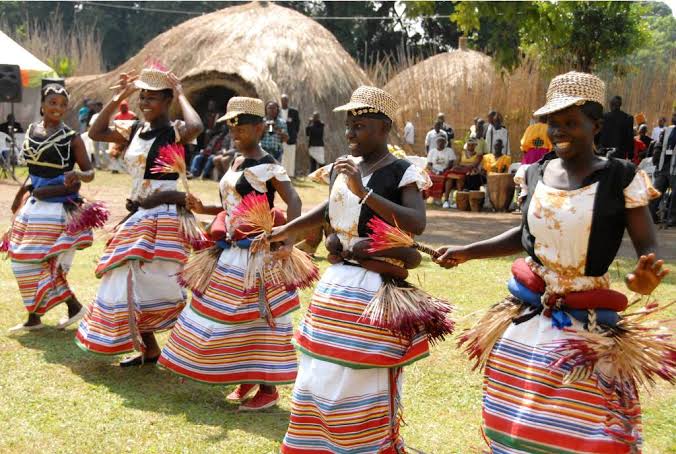
Traditional dance is far more than entertainment.
It expresses history, identity and community spirit.
Different dances accompany:
- Coronations
- Weddings
- Naming ceremonies
- Harvest festivals
- Clan gatherings
- Religious celebrations
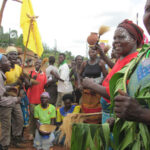
Colourful attire, energetic movements and rhythmic drumming create performances that unite communities while preserving traditions.
Today, cultural festivals organized by the Bunyoro-Kitara Kingdom continue to showcase these dances to younger generations and visitors.
Traditional Dress
Modern clothing is now common throughout Bunyoro.
However, traditional attire remains important during cultural and royal ceremonies.
Men often wear:
- The kanzu
- Jackets or ceremonial robes
- Traditional hats during some occasions
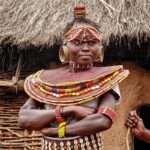
Women traditionally wear elegant dresses decorated with colourful fabrics and jewellery that reflect local craftsmanship.
Royal ceremonies feature distinctive regalia symbolizing the dignity and history of the kingdom.
Banyoro Cuisine
The fertile soils of western Uganda have long made Bunyoro an agricultural region.
Traditional meals are prepared from locally grown crops and livestock products.
Staple foods include:
- Matooke
- Millet bread
- Cassava
- Sweet potatoes
- Beans
- Groundnuts
- Sorghum
- Pumpkin
Protein is provided through:
- Beef
- Goat meat
- Chicken
- Fish from Lake Albert
- Fresh milk
Meals are often shared communally, reflecting the Banyoro belief that food strengthens family and friendship.
Visitors are traditionally welcomed with generosity, making hospitality one of the community’s defining cultural values.
Oral Tradition: Keeping History Alive
Long before books documented Banyoro history, knowledge was preserved through oral tradition.
Elders taught children about:
- The origins of the kingdom
- Famous kings
- Great battles
- Clan histories
- Moral lessons
- Community values
Storytelling sessions often took place in the evening, with families gathered around the fire.
These stories entertained young people while teaching wisdom, courage, honesty and respect.
Many of these oral traditions remain an important part of Banyoro cultural heritage today.
Culture in a Changing World
Like many African communities, the Banyoro have embraced modern education, technology and urban life.
Yet cultural preservation remains a priority.
The Bunyoro-Kitara Kingdom, schools and community organizations continue to promote:
- Runyoro language education
- Traditional music and dance
- Cultural festivals
- Historical research
- Youth leadership programmes
- Heritage tourism
By combining tradition with modern development, the Banyoro are ensuring that future generations inherit not only a proud history but also a living culture.
Economy, Trade and the Wealth of Bunyoro
The rise of the Bunyoro-Kitara Kingdom was not built on military strength alone. Its prosperity was driven by fertile land, valuable natural resources, skilled craftsmanship and strategic trade routes that connected the Great Lakes region with the wider African interior.
For centuries, the Banyoro developed an economy that supported one of East Africa’s most influential kingdoms. Today, while the region has embraced modern industries such as petroleum and tourism, agriculture remains the backbone of daily life, demonstrating the remarkable continuity of Banyoro enterprise.
Agriculture: The Lifeblood of Bunyoro
The fertile soils and reliable rainfall of western Uganda have long made Bunyoro one of the country’s most productive agricultural regions.
For generations, farming has provided food, income and social stability. Most families traditionally combined crop cultivation with livestock keeping, ensuring a balanced and sustainable livelihood.
Major crops include:
- Matooke (plantains)
- Cassava
- Sweet potatoes
- Millet
- Maize
- Beans
- Groundnuts
- Sorghum
- Rice
- Coffee
- Sugarcane
In recent decades, commercial farming has expanded, with farmers increasingly growing cash crops for national and international markets.
Agriculture continues to employ the majority of people in the region and remains central to food security.
Livestock Keeping
Cattle have always occupied a special place in Banyoro society.
Historically, owning cattle symbolized wealth, prestige and social standing. They provided:
- Milk
- Meat
- Hides
- Manure
- Bridewealth
- Income
Goats, sheep, pigs and poultry also play important roles in household economies.
Today, improved livestock breeding and veterinary services are helping farmers increase productivity while preserving traditional practices.
The Famous Kibiro Salt Works
Long before modern industries emerged, Bunyoro possessed one of East Africa’s most valuable natural resources—salt.
The Kibiro Salt Works, located on the eastern shores of Lake Albert, have been producing salt for centuries.
Salt was far more than a seasoning.
It was essential for:
- Preserving food
- Livestock health
- Trade
- Daily household use
Merchants travelled long distances to purchase Kibiro salt, making it one of Bunyoro’s most important trading commodities.
The salt industry contributed significantly to the kingdom’s prosperity and strengthened its influence throughout the Great Lakes region.
Even today, traditional salt production continues in Kibiro, offering visitors a rare glimpse into an ancient industry that has survived for generations.
Masters of Ironworking
One of Bunyoro’s greatest achievements was its advanced ironworking industry.
Long before European industrialization reached Africa, Banyoro blacksmiths had mastered the art of smelting iron ore and producing durable tools and weapons.
Their workshops produced:
- Hoes
- Spears
- Axes
- Knives
- Arrowheads
- Machetes
- Household tools
These products improved farming, strengthened the kingdom’s military and became highly sought after by neighbouring communities.
The reputation of Banyoro blacksmiths spread throughout the region, making ironworking one of the kingdom’s defining economic strengths.
Lake Albert: A Lifeline for Communities
Lake Albert has shaped the lives of the Banyoro for centuries.
Stretching along Uganda’s western border, the lake provides:
- Fresh fish
- Water for communities
- Transportation
- Trade opportunities
- Tourism
Fishing remains one of the region’s most important economic activities.
Species such as Nile perch and tilapia support thousands of households through commercial fishing, processing and trade.
The lake also attracts researchers, birdwatchers and tourists interested in its remarkable biodiversity.
Trade Networks That Connected Kingdoms
Bunyoro’s location made it a crossroads of regional commerce.
Merchants travelled through the kingdom exchanging goods with neighbouring societies.
Among the products traded were:
- Salt
- Iron tools
- Livestock
- Ivory
- Bark cloth
- Agricultural produce
- Pottery
- Fish
Trade created wealth while also encouraging the exchange of ideas, technologies and cultural traditions.
These commercial relationships helped establish Bunyoro as one of the most influential kingdoms in East Africa.
Oil and Gas: A New Economic Era
The discovery of commercially viable petroleum reserves in Uganda’s Albertine Graben has transformed Bunyoro into one of the country’s fastest-growing economic regions.
Major investments in:
- Oil production
- Pipelines
- Roads
- Airports
- Housing
- Hospitality
are reshaping the local economy.
Hoima, once known primarily as the royal capital of Bunyoro, is rapidly emerging as Uganda’s energy hub.
The petroleum industry has created new opportunities for employment, infrastructure development and business growth.
However, it has also sparked important discussions about:
- Environmental conservation
- Land rights
- Community participation
- Sustainable development
- Revenue management
Balancing economic progress with the protection of local communities and ecosystems remains one of the region’s greatest challenges.
Tourism: Discovering Bunyoro’s Heritage
Bunyoro is increasingly becoming one of Uganda’s most attractive cultural and eco-tourism destinations.
Visitors can explore:
- The Karuzika Royal Palace in Hoima
- The historic Kibiro Salt Works
- Lake Albert
- Murchison Falls National Park
- Traditional cultural festivals
- Royal ceremonies
- Community heritage sites
Tourism provides employment while encouraging the preservation of historical landmarks, traditional crafts and cultural performances.
As Uganda promotes domestic and international tourism, Bunyoro’s rich history places it in a unique position to benefit from growing visitor interest.
Education and Modern Enterprise
Education has become a powerful force in transforming Banyoro society.
Universities, technical institutes and vocational schools are producing graduates who contribute to:
- Business
- Public service
- Engineering
- Healthcare
- Education
- Information technology
Young entrepreneurs are also embracing innovation through:
- Agribusiness
- Digital services
- Manufacturing
- Tourism enterprises
- Small and medium-sized businesses
This combination of traditional knowledge and modern skills is helping prepare the region for future economic growth.
Challenges and Opportunities
Despite its many advantages, Bunyoro faces challenges that include:
- Youth unemployment
- Environmental degradation
- Climate change
- Pressure on natural resources
- Rapid urbanization
At the same time, opportunities continue to expand through:
- Oil and gas investment
- Improved transport infrastructure
- Agricultural modernization
- Tourism
- Renewable energy
- Education
- Regional trade
How these opportunities are managed will shape the future of the region for generations to come.
An Economy Built on Resilience
From ancient salt mines and iron furnaces to modern oil fields and expanding businesses, the Banyoro have repeatedly demonstrated their ability to adapt to changing times.
Their story is not one of a kingdom trapped in the past, but of a people who continue to build on centuries of enterprise, innovation and resilience.
Today, Bunyoro stands at the intersection of history and opportunity—a region where ancient traditions coexist with one of East Africa’s most significant economic transformations.
Bunyoro Today – Preserving a Great Kingdom for Future Generations
Although the Bunyoro-Kitara Kingdom no longer exercises political authority, it remains one of Uganda’s most respected cultural institutions. More than a century after colonial rule reshaped the kingdom and decades after traditional kingdoms were abolished and later restored, Bunyoro continues to play a vital role in preserving history, strengthening community identity and promoting development.
For the Banyoro, the kingdom is not simply a reminder of a glorious past. It is a living institution that connects generations, celebrates cultural pride and helps prepare young people for the future.
The Restoration of the Kingdom
Like Uganda’s other traditional kingdoms, Bunyoro experienced a difficult period following independence.
In 1967, the Ugandan government under President Milton Obote abolished all traditional kingdoms as part of constitutional reforms aimed at creating a more centralized state.
For more than two decades, the royal institution existed only in the memories and traditions of its people.
That changed in 1993, when the Ugandan government restored traditional kingdoms as cultural institutions.
The restoration marked a historic moment for the Banyoro, allowing the kingdom once again to serve as a guardian of culture, language and heritage.
Although the Omukama no longer governs politically, the kingdom plays an important cultural and developmental role.
The Omukama Today
The current Omukama, His Majesty Dr. Solomon Gafabusa Iguru I, is widely respected for promoting unity among the Banyoro and preserving one of Africa’s oldest royal traditions.
As cultural leader, the Omukama oversees activities that promote:
- Cultural heritage
- Education
- Environmental conservation
- Youth empowerment
- Tourism
- Community development
The royal court also works with government agencies, cultural organizations and development partners to encourage sustainable growth while protecting the kingdom’s traditions.
For many Banyoro, the Omukama remains a symbol of continuity, dignity and identity.
Preserving Language and Culture
Language remains one of the strongest pillars of Banyoro identity.
The kingdom actively encourages the teaching and use of Runyoro through:
- Schools
- Community programs
- Radio broadcasts
- Cultural festivals
- Literature
- Traditional music
These efforts ensure that younger generations remain connected to their heritage even as globalization and urbanization transform society.
Traditional dances, folktales, poetry and royal ceremonies continue to be documented and celebrated, helping preserve customs that have survived for centuries.
Cultural Festivals and Royal Ceremonies
Throughout the year, the kingdom hosts cultural events that attract visitors from across Uganda and beyond.
These celebrations feature:
- Traditional music
- Cultural dances
- Royal processions
- Storytelling
- Traditional foods
- Craft exhibitions
- Youth competitions
Such festivals strengthen community bonds while introducing younger generations to Banyoro history and customs.
They also provide valuable opportunities for cultural tourism, supporting local businesses and artisans.
Education and the Next Generation
The future of Banyoro culture depends largely on its young people.
Recognizing this, the kingdom has increasingly encouraged education, leadership and entrepreneurship.
Young Banyoro are pursuing careers in:
- Medicine
- Engineering
- Agriculture
- Business
- Information technology
- Law
- Education
- Public administration
At the same time, cultural leaders encourage them to remain proud of their traditions, language and history.
This balance between modern education and cultural preservation has become one of Bunyoro’s greatest strengths.
Bunyoro’s Role in Uganda’s Development
Today, the Bunyoro region is emerging as one of Uganda’s most strategically important economic areas.
Major investments in infrastructure, petroleum development, tourism and agriculture are creating new opportunities for communities.
Projects such as improved roads, industrial parks and energy developments are expected to transform the region over the coming decades.
The kingdom has consistently emphasized that development should benefit local communities while protecting cultural heritage and the environment.
This vision reflects a broader understanding that economic growth and cultural preservation can work together.
Challenges Facing the Kingdom
Like many traditional institutions across Africa, Bunyoro faces several challenges.
These include:
- Preserving cultural identity in an increasingly globalized world.
- Encouraging young people to learn the Runyoro language.
- Protecting historical sites from neglect.
- Balancing economic development with environmental conservation.
- Ensuring cultural traditions remain relevant to future generations.
Addressing these challenges requires cooperation between cultural leaders, government, educators and local communities.
Why the Banyoro Kingdom Still Matters
The history of Bunyoro is not only important to the Banyoro people—it is part of Africa’s shared heritage.
The kingdom demonstrates that long before colonial rule, African societies had developed:
- Organized governments
- Sophisticated legal systems
- Thriving economies
- International trade networks
- Advanced ironworking technology
- Rich cultural traditions
Its story challenges outdated narratives that underestimated Africa’s pre-colonial civilizations.
For students, historians and visitors, Bunyoro offers valuable lessons about leadership, resilience and cultural continuity.
Visiting Bunyoro Today
For travelers interested in Uganda’s history and culture, Bunyoro offers a unique experience.
Popular attractions include:
- Karuzika Royal Palace in Hoima
- Kibiro Salt Gardens
- Lake Albert
- Murchison Falls National Park
- Traditional cultural festivals
- Local museums
- Community cultural centres
Visitors can experience traditional music, local cuisine, royal history and breathtaking landscapes that have shaped Banyoro civilization for centuries.
As Uganda’s tourism industry continues to grow, Bunyoro is increasingly becoming a destination for those seeking authentic cultural experiences.
A Legacy That Lives On
Few African kingdoms have left as lasting an imprint on the history of the Great Lakes region as Bunyoro-Kitara.
Its kings ruled with authority, its craftsmen shaped economies, its traders connected distant communities and its people preserved traditions that continue to inspire generations.
Today, the Banyoro stand proudly between history and the future.
They honour the achievements of their ancestors while embracing education, innovation and sustainable development.
Their kingdom is no longer measured by the size of its territory but by the strength of its culture, the resilience of its people and the enduring influence of a civilization that helped shape East Africa.
The story of the Banyoro is far from over. It continues to unfold with every generation that speaks Runyoro, celebrates its traditions and carries forward the legacy of one of Africa’s greatest kingdoms.
Frequently Asked Questions (FAQ)
Who are the Banyoro?
The Banyoro are a Bantu-speaking ethnic community indigenous to western Uganda. They are the custodians of the historic Bunyoro-Kitara Kingdom, one of East Africa’s oldest and most influential traditional kingdoms.
Where is the Bunyoro Kingdom located?
The kingdom is located in western Uganda and covers the traditional homeland of the Banyoro, including Hoima, Masindi, Kikuube, Kagadi, Kakumiro, Kiryandongo and parts of Buliisa District.
Who is the current Omukama of Bunyoro?
The current cultural leader is His Majesty Dr. Solomon Gafabusa Iguru I, the Omukama (King) of Bunyoro-Kitara Kingdom.
What language do the Banyoro speak?
The Banyoro speak Runyoro, a Bantu language closely related to Rutooro. It is one of Uganda’s recognized indigenous languages and remains widely spoken throughout the kingdom.
Why was the Bunyoro-Kitara Kingdom important?
Bunyoro-Kitara became one of the most powerful kingdoms in the Great Lakes region because of its organized government, military strength, ironworking, salt production, agriculture and long-distance trade networks.
What happened to the kingdom during colonial rule?
In the late nineteenth century, Bunyoro resisted British colonial expansion under Omukama Kabalega. After years of conflict, the kingdom was defeated, and parts of its territory were transferred to Buganda under British administration. Despite these setbacks, the kingdom survived as a cultural institution and was officially restored in 1993.
Can tourists visit the Bunyoro Kingdom?
Yes. Visitors can explore the Karuzika Royal Palace, Kibiro Salt Gardens, Lake Albert, nearby Murchison Falls National Park and cultural festivals that celebrate Banyoro traditions throughout the year.
Did You Know?
- Bunyoro-Kitara is one of the oldest surviving traditional kingdoms in East Africa.
- Omukama Kabalega is remembered as one of Africa’s greatest anti-colonial resistance leaders.
- Kibiro has produced salt for hundreds of years using traditional methods that are still practiced today.
- The Albertine Graben, located within Bunyoro, contains some of Uganda’s largest petroleum reserves.
- Runyoro and Rutooro are so closely related that many speakers can understand each other.
- Bunyoro’s ironworkers were among the most skilled metal craftsmen in pre-colonial East Africa.
Why This History Matters Today
The story of the Banyoro is more than the story of one kingdom. It reflects the richness of Africa’s pre-colonial civilizations and demonstrates that long before colonial rule, African societies had developed sophisticated systems of leadership, commerce, technology and culture.
Understanding Bunyoro helps challenge outdated stereotypes about African history. It also highlights the importance of preserving languages, traditions and historical knowledge for future generations.
As Uganda continues to develop, the Banyoro remain a bridge between the past and the future—protecting an extraordinary heritage while contributing to the country’s economic and cultural growth.
Conclusion
The Banyoro Kingdom is one of Africa’s greatest historical treasures. From its rise as a dominant power in the Great Lakes region to its enduring role as a cultural institution in modern Uganda, Bunyoro’s story is one of resilience, innovation and pride.
Its rulers built a kingdom that thrived through strong leadership, thriving trade and remarkable craftsmanship. Its people preserved their identity through centuries of political change, ensuring that their language, customs and traditions would continue to flourish.
Today, the legacy of Bunyoro can still be seen in its royal institution, vibrant cultural festivals, fertile farmlands, historic landmarks and the determination of the Banyoro people to honour their past while embracing the future.
For anyone seeking to understand Uganda’s history—or Africa’s broader story—the Banyoro Kingdom stands as a powerful reminder that some of the continent’s greatest civilizations were built long before the modern era and continue to shape lives today.
Email Us on editorial@nnafrica.com