

A Continent Rich in Talent, Yet Short on World Cup Success
Every FIFA World Cup reignites hope across Africa. Millions of fans believe that this could finally be the tournament where an African nation lifts football’s biggest prize or at least reaches the final. Yet, despite producing some of the world’s finest footballers, African teams have repeatedly fallen short against Europe and South America’s traditional giants.
The disappointing performances of several African teams at recent World Cups have raised difficult questions. Why do nations blessed with exceptional talent struggle to compete consistently on football’s biggest stage? And is Morocco now the continent’s best chance of changing that narrative?
Individual Talent Does Not Always Produce Great Teams
African football has produced legends such as Didier Drogba, Samuel Eto’o, George Weah, Yaya Touré, Mohamed Salah, Sadio Mané and Victor Osimhen. These stars have excelled in Europe’s top leagues and won major club trophies.
However, international football demands more than individual brilliance. Successful World Cup teams combine tactical discipline, squad depth, long-term planning and consistency. Many African nations still struggle to build these foundations over several years.
Administrative Problems Continue to Hurt African Football
One of the biggest obstacles remains poor football administration.
In several countries, football federations have been affected by leadership disputes, financial challenges, delayed player bonuses, coaching instability and inadequate preparation before major tournaments.
When teams arrive at a World Cup distracted by off-field issues, they face opponents that have spent years preparing under stable football structures.
Tactical Discipline Often Makes the Difference
Modern international football is highly tactical.
European and South American teams spend years developing systems that players understand instinctively. Defensive organisation, pressing, transitions and set-piece routines are rehearsed extensively.
African teams often display exciting attacking football but can struggle with defensive concentration and tactical consistency against elite opposition. At the World Cup, a single mistake can decide an entire tournament.
Youth Development Is Improving but Still Uneven
Many African countries have talented young players, but structured youth development remains inconsistent.
Countries with successful football systems invest heavily in:
- Modern academies
- Qualified youth coaches
- Sports science
- Nutrition
- Player psychology
- Data analysis
While progress is being made across Africa, investment still varies widely between nations.
Morocco Has Changed the Conversation
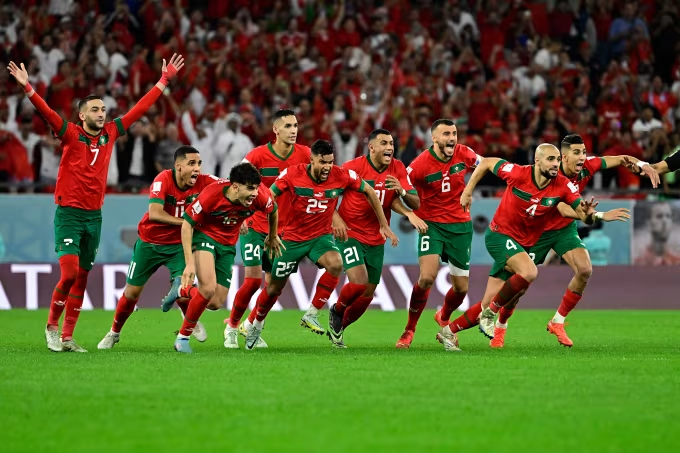
Morocco’s remarkable run to the semi-finals at the 2022 FIFA World Cup proved that an African nation can compete with the world’s best.
Rather than relying solely on individual stars, Morocco built success through:
- Tactical discipline
- Excellent defensive organisation
- Strong team spirit
- Experienced coaching
- Careful player development
- Stability within the football federation
Victories over Belgium, Spain and Portugal were not accidents. They reflected years of planning and investment.
Why Morocco Is Africa’s Greatest Hope
Morocco stands out because it combines several advantages rarely found together.
A Clear Football Vision
The country has invested heavily in football infrastructure, including modern training facilities and youth development programmes.
World-Class Coaching
The national team has shown tactical flexibility, adapting its style to different opponents while maintaining discipline.
Players at Elite Clubs
Many Moroccan internationals compete regularly in Europe’s strongest leagues, bringing valuable experience against top opposition.
Strong Federation Support
Administrative stability has allowed the coaching staff and players to focus on football rather than internal disputes.
Other African Nations Can Still Challenge
Morocco is not Africa’s only hope.
Countries such as Senegal, Egypt, Nigeria, Ivory Coast, Algeria and Ghana continue to produce outstanding footballers and remain capable of deep tournament runs.
However, sustained success will depend on building stronger football systems rather than relying solely on gifted individuals.
The Road Ahead
African football is improving every year. Better academies, greater investment and growing international experience are helping close the gap with the world’s traditional powers.
The expanded FIFA World Cup also gives more African nations opportunities to gain experience against elite competition.
If more countries adopt long-term planning similar to Morocco’s, Africa’s chances of reaching another semi-final—or even a final—will become much stronger.
Conclusion
Africa’s World Cup disappointments cannot be explained by a lack of talent. The continent continues to produce some of football’s brightest stars. The greater challenge lies in creating stable football structures, investing in youth development and maintaining tactical consistency at the highest level.
Morocco has demonstrated that with careful planning, strong leadership and a unified vision, an African nation can challenge the world’s elite. While no team is guaranteed success, Morocco currently offers the clearest blueprint for how Africa can transform its immense football potential into lasting World Cup achievement.
Email Us on editorial@nnafrica.com