

In this interview with Africa Renewal’s Franck Kuwonu the Director of the Museum of Black Civilisations in Dakar Mohamed Abdallah Ly reflects on the urgent need to decolonize cultural institutions, the symbolism of absence, and the politics of restitution. He also discusses efforts to reconnect the museum with diaspora communities and reimagine its role in Africa’s cultural and intellectual future. The excerpts from this interview were translated from its original French:
Africa Renewal: For those who have heard of the museum without knowing much about it, if you had to explain the original vision behind its creation, what would you tell them?
Mr. Mohamed Abdallah Ly: In reality, this museum is the fruition of a long-term project. Although it has only been in existence for six years, it has made a remarkable entry onto the world stage, ‘on grey hairs.’ I use this expression to underline the contrast with the often-unrecognised history of those who have carried the vision from its origins.
What is fundamental to emphasise is the contribution of President Léopold Sédar Senghor [the first president of Senegal and a poet] his major, even founding contribution.
Indeed, it was in the aftermath of the First World Festival of Negro Arts held in Dakar in 1966—a moment of pan-African convergence of rare intensity, bringing together the African diaspora from all over the world around large-scale cultural and intellectual events—that the President had the idea of creating a museum of civilisations. He then conceptualised the project, defined its broad outlines and even proposed its location.
A ‘New-born with Grey hair’, you say. But does the location of the museum match up to what President Senghor had imagined?
The location had to be changed because of the city’s development. The original location isn’t too far away but presents several challenges. Originally, President Senghor had thought of what he called the Arts Village, a space with several dedicated areas.
Later, a new location was chosen—one that remained in the same geographical area, in the spirit of the great Arts Village.
How does the museum position itself in the global movement advocating the recognition of black cultural heritage and the restitution of works of art?
The museum is often mentioned in debates on restitution, debates which in recent years have been somewhat rancorous. Yet this is not a new debate. For example, people have been speaking out on this subject since 1966, notably in the film Afrique sur Seine [Africa on the Seine], or through the interventions of figures such as Cheikh Anta Diop [Senegalese historian and politician] and Amadou-Mahtar Mbow. Under Mbow’s leadership, UNESCO adopted a very clear stance on the need to return cultural property.
So, it’s an old question. There are many references to it in scientific works and biographical landmarks. But recently, as we have all seen, the debate has been revived, by young Africans not only in Africa but also in the diaspora. These young people are mobilised around issues of decolonising knowledge, breaking with systemic racism, sovereignty and challenging the unequal world order.
This renewed debate has also been fueled by modern forms of activism, made easier by new technologies, particularly the Internet, which have given a wider audience to sometimes spectacular actions carried out by what are now known as ‘restituers’. Some have even attempted to snatch objects from museums in Western countries, leading to high-profile court cases.
The Museum of Black Civilisations has often been cited in this context. Why? Because those opposed to the restitution often cited the lack of infrastructure capable of housing and conserving the returned works in accordance with international standards. With the inauguration of this museum in December 2018, this argument no longer holds water. That’s why it often comes up in discussions.
But if we take stock today, there is only one object that has really been received by the museum —The Sabre. And even this is a matter of debate, since from a legal point of view it is officially a loan. What is your take on this?
One of the main reasons for this is the inalienability of heritage in France, a legal principle that continues to be referenced as the reason for not returning items.
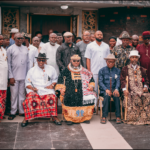
However, the return of The Sabre was celebrated in a very official way: it was former French Prime Minister Edouard Philippe who, at the head of a large delegation, handed it over at a ceremony at the Palais de la République. An agreement was signed at the time. All the major religious families and notables were represented.
This moment revived the debate on restitution and put the issue back in the spotlight. But today, it is legitimate to ask why, six years on, the number of objects returned remains so low.
Does this mean that, technically, there could come a time when visitors to the Museum of Black Civilisations will no longer be able to see the Sabre, because it would have to be returned to France?
It is a possibility, as it is supposed to be there under the terms of a loan.
That said, the question of the destination of objects remains a recurring subject of debate. Another argument often put forward is: to whom should these objects revert? Some fear multiple claims, whether by different States or communities.
On this point, I would like to emphasise that there has been no conflict, either between States or between communities. The person to whom The Sabre belonged to is both a transnational and transcommunity figure – Mr. El Hadj Omar Tall.
Mr. Omar Tall’s family wished to entrust this object to the Museum of Black Civilisations in Dakar. Better still, they are now claiming other objects linked to this heritage. The Sabre is part of a larger collection, known as the loot or treasure of Ségou, which includes hundreds of manuscripts, as well as other objects such as jewellery, weapons and so on.
The family has expressed its intention to entrust many of these objects to the museum. They reaffirmed this recently, in December 2024, at an exhibition we organised on the issue of restitution, where they were represented.
In practice, how does the Museum of Black Civilisations argue for and defend the restitution of cultural property?
So, under the direction of my predecessor, there was a symposium on restitution. He was involved in communications on this issue. But I felt, as far as the Museum of Black Civilisations was concerned, we needed to go further—in any case, to revive the debate on restitution. But how?
When we welcomed The Sabre, it was included in an exhibition entitled: L’appropriation africaine des religions abrahamiques (The African appropriation of Abrahamic religions).
This exhibition took a fresh look at the way in which we Africans have appropriated different religions—Catholic, Muslim, etc.—according to our contexts, our sensitivities and our beliefs. The exhibition featured manuscripts, relics and a variety of objects illustrating this appropriation, such as Senegalese Confraternity Islam, with its unique spiritual and cultural dimensions.
So, we integrated The Sabre into this gallery. But very quickly, we wanted to isolate it.
Why did we do this?
Because presented in this way, in this museum context, it no longer really told its own story. It no longer said what it carried within it—a fight, a memory, a resistance.
So, through a guided tour, we wanted to provoke thought: why this Sabre alone among so many other objects destined for restitution?
And here, we must go back to 2017. That year, President Emmanuel Macron of France, in a speech to African students in Ouagadougou, Burkina Faso, declared that France was committed to organising, within five years, a massive restitution of African cultural heritage.
Through this new exhibition and the spotlight on The Sabre, we wanted to remind people of that promise, and ask the question: why, six years on, has it not been kept?
The returned Sabre
- The Sabre refers to the Sabre of El Hadj Omar Tall, a 19th-century West African Islamic scholar, military leader, and anti-colonial resistance figure who led military campaigns across parts of what are now Senegal, Mali, and Guinea and founded the Toucouleur Empire.
- The Sabre had been held for over a century in France, and its return to Senegal in November 2019 marked a symbolic and significant moment in the growing movement for the restitution of African cultural heritage.
- It was one of the first major objects returned by a former colonial power following increasing calls for the repatriation of African artifacts.
- Including The Sabre in the Museum of Black Civilisations’ exhibition contextualizes it not only as a historical object but also as a symbol of African resistance, memory, and the evolving dialogue on restitution and identity.
In the end, the fact that The Sabre was isolated in such a vast room, with no other objects around, was a deliberate choice—one that carried a specific message?
It was a decision taken by the in-house curatorial and scientific team. This is worth emphasising, because very often, in many exhibition designs, some decisions are taken with the help of outside experts. In this case, however, it was the in-house team that was responsible for the vision and they took full responsibility for it. It was a deliberate choice, with a clear message.
So, the Museum of Black Civilisations isn’t simply fitting into an existing model, it’s creating something new – isn’t it? So, if you had a particular plea to make at this point in the Museum’s trajectory, what would you say?
I think any strengthening of the museum’s pan-African and diaspora vocation, in whatever form, is a welcome contribution. This is one of its fundamental purposes, both because of its history and also because of the vision we have of what this museum should be.
We are convinced that the systemic structures of inequality in the world – be they political, economic or diplomatic—are rooted in the joint invention of capitalism and slavery. And if we want to build a truly post-colonial world, one that is fairer and shows greater solidarity, then at some point we will have to make reparations. A growing global consensus acknowledges the need for restitution and dialogue.
Email Us on editorial@nnafrica.com