

Uganda is home to dozens of indigenous communities, each carrying its own history, language, traditions, beliefs, and way of life. Among the country’s lesser-known communities are the Kebu, a small cultural group associated with the West Nile region.
Unlike Uganda’s largest ethnic communities, whose histories are widely represented in books, media, and academic research, smaller communities such as the Kebu often receive far less attention.
Yet their stories are equally important.
The Kebu form part of the remarkable cultural mosaic of northwestern Uganda, a region where different peoples have interacted for generations across today’s borders with South Sudan and the Democratic Republic of Congo.
Who Are the Kebu?
The Kebu are a small indigenous community associated with northwestern Uganda, particularly the wider West Nile cultural environment.
Their communities have historically interacted with neighboring peoples, resulting in a cultural landscape characterized by multilingualism, trade, intermarriage, and shared traditions.
Because the Kebu are relatively small compared with communities such as the Lugbara, Alur, Madi, and Kakwa, information about their traditional life is less widely documented.
This makes preservation of their oral history particularly important.
The Importance of Oral History
For smaller communities, history is often carried not primarily in written books but through people.
Parents, grandparents, clan elders, storytellers, and community leaders have traditionally transmitted knowledge through:
- Stories
- Proverbs
- Songs
- Genealogies
- Family histories
- Traditional ceremonies
- Everyday conversations
These traditions can explain where families originated, how communities migrated, relationships between clans, and the values considered important by previous generations.
The loss of elders without recording their knowledge can therefore mean the loss of irreplaceable cultural information.
Family and Community Life
Like many communities in northern Uganda, Kebu social life has traditionally revolved around extended families and kinship networks.
Family relationships provide support in:
- Raising children
- Farming
- Marriage
- Community celebrations
- Caring for older people
- Resolving disagreements
Elders traditionally occupy an important position because of their knowledge of family history and customary practices.
Community cooperation is particularly valuable in rural areas, where agricultural activities often require collective effort.
Clans and Identity
Clan and family identity have traditionally been important aspects of belonging.
Clans can provide a framework for understanding:
- Family relationships
- Marriage
- Inheritance
- Social responsibilities
- Cultural obligations
For small communities, clan histories can be especially valuable because they preserve information about ancestry and migration.
Recording these histories can help younger generations understand their connection to earlier generations.
Language and Cultural Identity
Language is one of the most important markers of cultural identity.
For the Kebu, preserving their indigenous speech and vocabulary is particularly significant because smaller languages can become vulnerable when speakers increasingly adopt larger regional or national languages.
Young people may use English, Swahili, Luganda, or neighboring local languages more frequently because of school, employment, migration, and urbanization.
However, an indigenous language carries much more than everyday communication.
It contains:
- Traditional names
- Proverbs
- Songs
- Stories
- Family histories
- Traditional knowledge
- Cultural expressions
When a language disappears, much of this knowledge can disappear with it.
Traditional Homes
Traditional rural homes in the wider West Nile region were commonly constructed from materials available locally.
These could include:
- Mud
- Wooden poles
- Grass
- Reeds
Homesteads were organized around family life, with spaces for sleeping, cooking, storing grain, and keeping livestock.
Modern housing has transformed the appearance of many communities, with brick walls and iron-sheet roofs increasingly replacing traditional structures.
Nevertheless, traditional architectural knowledge remains an important part of cultural heritage.
Food and Agriculture
Agriculture has traditionally been central to life in northwestern Uganda.
Small-scale farmers grow crops such as:
- Cassava
- Maize
- Millet
- Sorghum
- Groundnuts
- Beans
- Sesame
- Sweet potatoes
Livestock keeping also contributes to household livelihoods.
Traditional food preparation is another area of cultural knowledge worth preserving. Recipes, methods of processing crops, and ways of preparing seasonal foods are often passed from one generation to another within families.
Marriage and Family Traditions
Marriage traditionally connects families and wider kinship networks.
Traditional marriage practices may involve:
- Family introductions
- Discussions between relatives
- Bridewealth arrangements
- Elders’ participation
- Community celebrations
- Music and dancing
Practices may vary according to family and location, particularly because smaller communities often live alongside neighboring ethnic groups and experience cultural exchange.
Modern marriages increasingly combine customary practices with church or civil ceremonies.
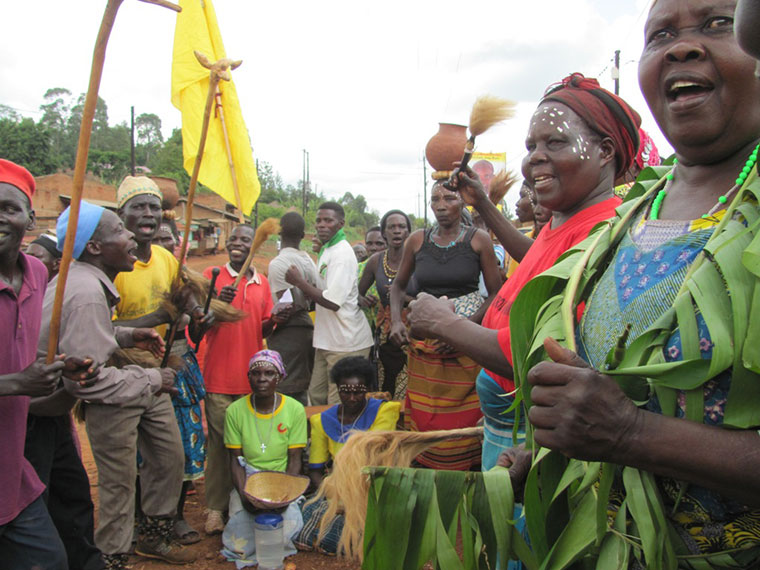
Music, Dance and Storytelling
Music and storytelling have traditionally served as forms of entertainment and education.
Songs can celebrate:
- Marriage
- Harvests
- Family
- Community achievements
- Important historical events
Stories and proverbs can teach younger people about honesty, courage, respect, cooperation, and responsibility.
This makes traditional entertainment an important form of informal education.
Traditional Beliefs and Religion
Like many communities in northern Uganda, the Kebu cultural heritage has been influenced by changing religious traditions.
Traditional spiritual beliefs historically provided explanations for nature, community life, ancestors, and important events.
Today, Christianity and other modern religious traditions have influenced many families.
However, religious change does not necessarily erase cultural identity. Language, family relationships, food, music, oral history, and respect for elders can continue to connect communities with their past.
Economic Life
The traditional economy has largely depended on rural livelihoods.
Important activities include:
- Crop farming
- Livestock keeping
- Small-scale trade
- Craftsmanship
- Local commerce
The growth of towns and improved transport has gradually expanded opportunities beyond subsistence agriculture.
Younger members of the community increasingly participate in education, professional employment, entrepreneurship, and other modern sectors.
The Kebu and the West Nile Cultural Landscape
One of the most interesting aspects of Kebu heritage is the wider environment in which the community exists.
West Nile is home to several cultural communities, including:
- Lugbara
- Madi
- Kakwa
- Alur
- Aringa
- Kebu
These communities have interacted through trade, migration, marriage, and shared geographical spaces for generations.
The result is a cultural landscape in which traditions sometimes overlap while individual communities retain distinctive identities.
Why Small Communities Matter
The Kebu story raises an important question:
What happens when a small cultural community is forgotten?
Cultural diversity is not determined only by population size.
A small community may possess:
- Unique oral traditions
- Distinctive vocabulary
- Ancient family histories
- Traditional ecological knowledge
- Unique songs and dances
- Specialized crafts
- Historical knowledge unavailable elsewhere
Preserving these traditions therefore benefits the entire country.
Uganda’s cultural heritage is strongest when both its large and small communities are represented.
Preserving Kebu Heritage
The preservation of Kebu heritage could involve several practical measures.
Document Oral Histories
Elders can be interviewed and their stories recorded in audio or video.
Preserve the Language
Young people can be encouraged to speak and learn the community’s indigenous language at home.
Record Family Histories
Clan and family genealogies can be documented before important knowledge is lost.
Preserve Traditional Music
Songs and dances can be recorded and taught to younger generations.
Document Food and Agriculture
Traditional recipes, farming techniques, and methods of processing crops can be preserved for future generations.
Use Digital Technology
Websites, documentaries, podcasts, social media, and digital archives can introduce Kebu heritage to young Ugandans and the African diaspora.
Did You Know?
- The Kebu are among Uganda’s lesser-known cultural communities.
- Their heritage forms part of the culturally diverse West Nile region.
- Oral history is particularly important for preserving the traditions of smaller communities.
- Agriculture has traditionally been central to rural livelihoods.
- Cultural preservation can help ensure that small communities remain visible in Uganda’s national heritage.
Quick Facts
| Feature | Information |
|---|---|
| Region | Northwestern Uganda |
| Cultural Area | West Nile |
| Community Size | Relatively small |
| Traditional Organization | Families, clans and elders |
| Main Livelihoods | Agriculture, livestock keeping and trade |
| Important Heritage | Oral history, language, family traditions and music |
Conclusion
The Kebu may not be one of Uganda’s most widely known communities, but their heritage is an important part of the country’s cultural story.
Their history demonstrates why cultural preservation should not focus only on the largest ethnic groups. Every community carries knowledge that can help future generations understand Uganda’s past.
For the Kebu, preserving language, oral history, family traditions, music, food, and ancestral knowledge is particularly important because smaller communities can face greater risks of cultural erosion.
Their story is ultimately a reminder that Uganda’s cultural wealth lies not only in its famous kingdoms and large ethnic groups, but also in the smaller communities whose histories are waiting to be documented and remembered.
Email Us on editorial@nnafrica.com