


For decades, one of Africa’s biggest agricultural challenges has not been growing food—it has been keeping it fresh.
Across the continent, millions of tonnes of fruits, vegetables, milk, fish, and other fresh produce spoil before reaching consumers. For small-scale farmers, this often means months of hard work end in financial loss.
But in Kenya, a quiet revolution is changing that story.
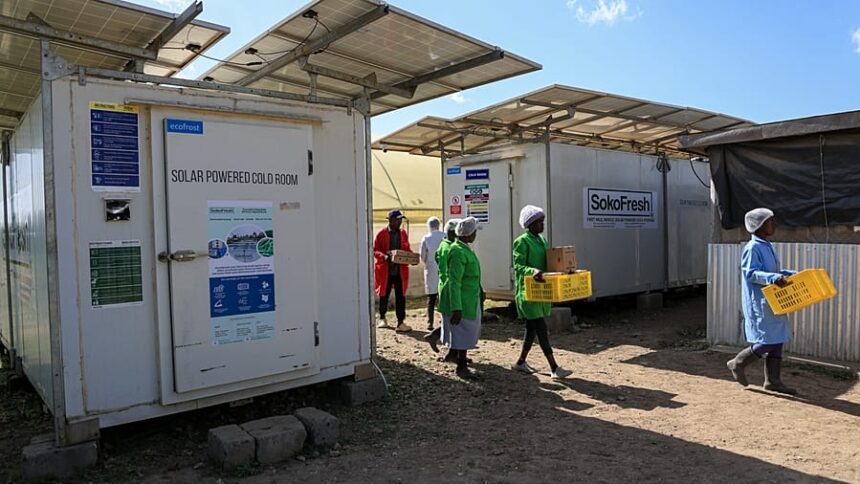
Solar-powered cold-storage facilities are helping farmers preserve their harvests for longer, reduce post-harvest losses, and earn more from their produce. What began as an innovative solution to a persistent problem is now attracting attention from governments, investors, and agricultural experts across Africa.
Many believe Kenya’s approach could become a blueprint for strengthening food security across the continent.
The Hidden Cost of Food Waste
Agriculture employs millions of Africans and contributes significantly to national economies.
Yet experts estimate that a large share of fresh produce is lost before it ever reaches markets because of poor storage, unreliable electricity, and weak transport infrastructure.
For farmers, the consequences are severe.
When vegetables, fruits, dairy products, or fish spoil, families lose income, food prices rise, and consumers have fewer choices.
Reducing these losses can be just as important as increasing production.
A Simple Idea With Big Results
Kenya’s expanding network of solar-powered cold-storage units is helping to solve this challenge.
Instead of rushing to sell produce immediately after harvest—often when market prices are low—farmers can safely store it for several days while waiting for better prices or transport.
Powered by renewable energy, these facilities are particularly valuable in rural communities where electricity supply can be unreliable.
The result is less waste, better-quality produce, and higher incomes for farming households.
Farmers Are Seeing the Difference
Many farmers who use cold-storage services report significant improvements in their businesses.
Fresh produce lasts longer.
Buyers receive higher-quality products.
Farmers have more flexibility to negotiate prices instead of accepting the first offer available.
This additional bargaining power can make a meaningful difference to household incomes, especially for small-scale producers.
For many families, the technology is not simply preserving food—it is protecting livelihoods.
A Win for the Environment
Reducing food waste also benefits the environment.
When food spoils, the land, water, energy, and labour used to produce it are effectively wasted.
By preserving more of each harvest, cold-storage technology improves resource efficiency while reducing greenhouse gas emissions associated with food loss.
Combined with solar power, the system also reduces dependence on fossil fuels and helps promote cleaner agricultural practices.
Could the Rest of Africa Follow?
Kenya’s success is generating interest across the continent.
Countries facing similar challenges—including Uganda, Tanzania, Rwanda, Nigeria, Ghana, Zambia, and Malawi—are exploring ways to expand modern storage infrastructure for farmers.
Agricultural experts believe wider investment in cold chains could significantly improve food security while creating new jobs in logistics, processing, and agribusiness.
The opportunity is enormous.
Challenges Still Remain
Despite encouraging progress, scaling up cold-storage technology will require continued investment.
Many rural communities still lack access to affordable storage facilities.
Financing, maintenance, technical training, and transport infrastructure remain obstacles in many regions.
Governments, private investors, development partners, and farmer cooperatives all have important roles to play in expanding these solutions.
Why This Matters for Africa
Africa’s population continues to grow rapidly, increasing demand for affordable and nutritious food.
Improving agricultural productivity is important—but preventing food from being lost after harvest may be equally critical.
By investing in technologies that reduce waste, African countries can strengthen food security, improve rural incomes, and build more resilient agricultural systems.
Kenya’s experience demonstrates that innovation does not always require massive industrial projects.
Sometimes, a practical solution to a long-standing problem can transform an entire sector.
Final Thoughts
Kenya’s cold-storage revolution offers a glimpse of what is possible when technology, renewable energy, and agriculture come together.
It is helping farmers earn more, reducing food waste, protecting the environment, and strengthening food systems.
As other African countries search for ways to feed growing populations and improve rural livelihoods, Kenya’s model may provide one of the continent’s most valuable lessons.
The future of African agriculture may not depend only on producing more food.
It may depend on ensuring that far less of it goes to waste.
Email Us on editorial@nnafrica.com