

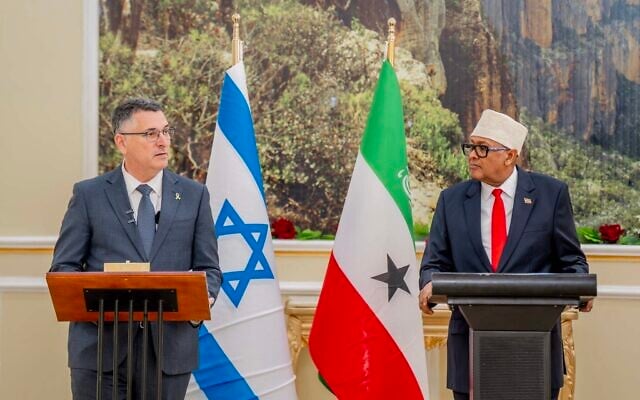
A diplomatic visit that might once have attracted little attention has become one of the most talked-about political stories in the Horn of Africa.
Somaliland President Abdirahman Mohamed Abdullahi, popularly known as “Irro,” is visiting Israel, a move that has triggered widespread discussion among political analysts, diplomats, and citizens across Africa and the Middle East.
Supporters describe the visit as a bold attempt to expand Somaliland’s international partnerships.
Critics argue it could further complicate one of Africa’s longest-running territorial disputes.
Whatever the outcome, the visit has placed Somaliland firmly back in international headlines.
Why Somaliland Matters
Somaliland declared independence from Somalia in 1991 following the collapse of Somalia’s central government.
Since then, it has established its own government, parliament, military, police force, currency, and electoral system.
Despite operating as a self-governing territory for more than three decades, Somaliland has not received widespread international recognition as an independent state.
Most countries, the African Union, and the United Nations continue to recognize Somaliland as part of Somalia.
That makes every high-level diplomatic engagement closely watched around the world.
Why Israel?
Israel has increasingly sought to strengthen relationships with African countries in areas such as agriculture, water management, technology, cybersecurity, renewable energy, and trade.
For Somaliland, deeper cooperation with Israel could provide opportunities for investment, technical expertise, and international visibility.
Observers also point to Somaliland’s strategic location along the Gulf of Aden—one of the world’s busiest maritime trade routes—as a factor that makes the territory geopolitically significant.
Somalia’s Position
The Somali government has consistently maintained that Somaliland remains an integral part of Somalia.
Officials in Mogadishu have repeatedly opposed any international actions they believe could be interpreted as recognizing Somaliland’s independence.
As a result, diplomatic engagements involving Somaliland often generate strong political reactions.
The latest visit is expected to add another layer of complexity to already sensitive relations between the two sides.
Why the Horn of Africa Is Watching
The Horn of Africa is one of the world’s most strategically important regions.
It borders the Red Sea and the Gulf of Aden, through which a significant share of global trade passes each year.
Countries including Ethiopia, Djibouti, Eritrea, Somalia, and Somaliland all play important roles in regional security, maritime trade, and international diplomacy.
Any new political or diplomatic alignment in the region attracts global attention.
Opportunities and Risks
Supporters of Somaliland’s outreach argue that expanding international partnerships could help boost investment, infrastructure development, tourism, and economic growth.
Access to new markets and advanced technologies could also strengthen key sectors such as agriculture, healthcare, education, and digital innovation.
However, critics warn that such moves could increase diplomatic tensions if they are viewed as undermining Somalia’s sovereignty or altering the region’s political balance.
The challenge will be finding ways to encourage cooperation while avoiding greater instability.
Africa’s Diplomatic Balancing Act
African governments have traditionally supported the principle of respecting existing borders to avoid encouraging separatist movements elsewhere on the continent.
At the same time, many observers acknowledge Somaliland’s long record of maintaining relative stability, conducting elections, and building functioning public institutions.
These competing realities continue to make Somaliland one of Africa’s most complex diplomatic questions.
What Happens Next?
Much will depend on the outcomes of the visit.
If agreements on trade, technology, agriculture, or security emerge, Somaliland could strengthen its international profile without necessarily gaining formal recognition.
If the visit leads to wider diplomatic engagement with other countries, it may reignite discussions about Somaliland’s future status on the international stage.
For now, political analysts across Africa are watching closely.
Final Thoughts
Somaliland’s engagement with Israel is about far more than a single diplomatic visit.
It reflects changing geopolitical interests, growing competition for influence in the Horn of Africa, and Somaliland’s continuing search for international partnerships.
Whether the visit marks the beginning of a new diplomatic chapter or simply another moment in a long political journey remains to be seen.
One thing is certain: the Horn of Africa has once again become one of the most closely watched regions on the continent.
Email Us on editorial@nnafrica.com