

At Uganda’s northwestern frontier, where the country’s borders meet South Sudan and the Democratic Republic of Congo, lives the Kakwa people. Their homeland is a remarkable cultural crossroads where communities, languages, trade routes, and traditions have interacted for generations.
The Kakwa have built a distinctive cultural identity shaped by agriculture, family, clan relationships, trade, and their position within the wider Central Sudanic cultural world.
Their story is particularly fascinating because the Kakwa are not confined to one modern country. Communities sharing Kakwa heritage live across Uganda, South Sudan, and the Democratic Republic of Congo, reflecting a history that existed long before today’s international boundaries.
Who Are the Kakwa?
The Kakwa are a Central Sudanic-speaking people found mainly in the West Nile region of northwestern Uganda.
In Uganda, Kakwa communities are particularly associated with Koboko District and surrounding areas.
Related Kakwa communities also live in:
- South Sudan
- Democratic Republic of Congo
Their cross-border presence makes the Kakwa an important example of how African cultural identities often extend beyond modern national boundaries.
Origins and History
The history of the Kakwa is closely connected to the wider movements of Central Sudanic-speaking peoples across the region.
Oral traditions preserve different accounts of Kakwa origins and migration. Over generations, communities settled across what is now northwestern Uganda, southern South Sudan, and northeastern Democratic Republic of Congo.
The Kakwa developed settlements based largely on farming, livestock keeping, hunting, and trade.
Their location also placed them along important routes connecting communities across the three countries.
Traditional Leadership and Community Organization
Traditional Kakwa society was largely organized around clans and extended families.
Rather than depending on one centralized kingdom, communities relied on:
- Clan elders
- Family heads
- Local leaders
- Councils of respected community members
Elders played important roles in settling disputes, preserving customary practices, advising families, and maintaining social harmony.
This emphasis on community consultation helped maintain relationships within and between clans.
Clans and Family Life
The clan is an important element of Kakwa identity.
Clan relationships traditionally influence:
- Marriage
- Family responsibilities
- Inheritance
- Social relationships
- Conflict resolution
- Cultural ceremonies
Extended families have historically been important units of economic and social life.
Children learn cultural values through parents, grandparents, elders, stories, songs, and participation in community activities.
The Kakwa Language
The Kakwa speak Kakwa, a Central Sudanic language associated with the wider Kresh and related linguistic environment of the region.
The language is an important part of Kakwa identity and has historically been transmitted through family and community life.
Like many African indigenous languages, Kakwa carries cultural knowledge through:
- Proverbs
- Folktales
- Songs
- Riddles
- Oral histories
Preserving the language is therefore closely connected to preserving the community’s wider cultural heritage.
Traditional Homes
Traditional Kakwa settlements were adapted to the warm climate and agricultural lifestyle of the region.
Homes were commonly constructed using locally available materials such as:
- Mud
- Wooden poles
- Grass
- Reeds
Family compounds could include separate structures for sleeping, cooking, grain storage, and livestock.
Today, modern brick and iron-sheet houses are increasingly common, particularly in growing towns and trading centers.
Food and Cuisine
Agriculture has traditionally provided the foundation of Kakwa food culture.
Common foods include:
- Cassava
- Maize
- Millet
- Sorghum
- Sweet potatoes
- Beans
- Groundnuts
- Sesame
- Chicken
- Goat meat
- Beef
Local vegetables and seasonal fruits also form part of the traditional diet.
Food is more than sustenance in Kakwa society. Sharing meals with relatives, visitors, and neighbors reinforces relationships and hospitality.
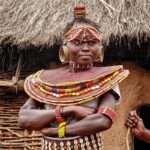
Traditional Dress and Adornment
Modern clothing dominates everyday life among the Kakwa today.
Traditional forms of dress and adornment remain visible during cultural celebrations, weddings, festivals, and other important occasions.
Beads, necklaces, bracelets, colorful fabrics, and ceremonial accessories can be used to express cultural identity.
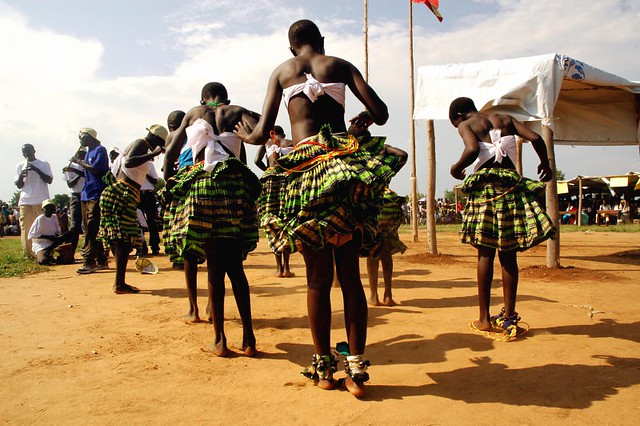
Music, Dance and Oral Tradition
Music and storytelling have historically been important methods of preserving Kakwa culture.
Traditional performances may feature:
- Drums
- Singing
- Dancing
- Flutes
- Rhythmic instruments
Songs and stories can communicate lessons about:
- Family
- Courage
- Morality
- Farming
- Community responsibility
- Historical events
For generations, oral tradition has allowed knowledge to survive even without written records.
Marriage and Family Customs
Marriage traditionally connects not only two individuals but also their families and clans.
Customary marriage may involve:
- Introduction of the families
- Negotiations between relatives
- Bridewealth discussions
- Blessings from elders
- Community celebrations
- Music and dancing
The exact practices vary between families and communities, particularly because Kakwa people live across three countries.
Modern marriages increasingly combine customary traditions with religious or civil ceremonies.
Spiritual Beliefs and Religion
Traditional Kakwa spirituality included belief in a supreme creator and respect for ancestors and the spiritual significance of particular places and practices.
Today, Christianity is widespread among Kakwa communities, particularly in Uganda and South Sudan. Other religious traditions are also represented.
Despite religious changes, many cultural values associated with respect for elders, family responsibility, community solidarity, and traditional ceremonies remain important.
Economic Activities
The Kakwa have traditionally depended heavily on agriculture.
Important economic activities include:
- Cassava farming
- Maize cultivation
- Groundnut production
- Sesame growing
- Livestock keeping
- Trade
- Small businesses
- Cross-border commerce
Koboko’s location near the borders with South Sudan and the Democratic Republic of Congo gives trade an especially important role in the local economy.
The Kakwa and Cross-Border Culture
One of the most interesting aspects of Kakwa heritage is its international character.
A Kakwa family may have relatives, cultural connections, or ancestral links across Uganda, South Sudan, and the Democratic Republic of Congo.
Modern borders therefore divide communities that historically interacted within the same cultural landscape.
This makes Kakwa heritage particularly valuable for understanding the interconnected nature of African societies.
Famous Sons and Daughters
The Kakwa have produced notable figures in politics, military service, business, education, and public administration.
The most internationally recognized Kakwa figure is Idi Amin Dada, Uganda’s former military ruler and president, who was born in the West Nile region.
His historical legacy is highly controversial because of the extensive human-rights abuses committed during his rule. His background nevertheless makes him one of the most internationally recognized figures associated with the Kakwa community.
Beyond political history, Kakwa professionals have contributed to Uganda and the wider region in education, healthcare, commerce, religion, and public service.
Preserving Kakwa Heritage
The Kakwa face the same challenge experienced by many smaller cultural communities: maintaining indigenous traditions while younger generations increasingly live in cities and interact with multiple cultures.
Cultural preservation efforts can focus on:
- Teaching the Kakwa language
- Recording oral histories
- Preserving traditional songs
- Documenting clan histories
- Supporting cultural festivals
- Teaching traditional crafts
- Encouraging young people to learn from elders
Digital technology also offers new opportunities to record and share Kakwa history with the global African diaspora.
Did You Know?
- The Kakwa are found in Uganda, South Sudan, and the Democratic Republic of Congo.
- Their homeland lies in one of East Africa’s important cultural borderlands.
- The Kakwa are traditionally organized around clans and extended families rather than a centralized kingdom.
- Agriculture and cross-border trade have historically supported Kakwa communities.
- Their cultural heritage demonstrates how ethnic identities can extend across modern international borders.
Quick Facts
| Feature | Information |
|---|---|
| Region in Uganda | West Nile |
| Major Ugandan Area | Koboko District |
| Language | Kakwa |
| Cultural Group | Central Sudanic |
| Countries | Uganda, South Sudan, Democratic Republic of Congo |
| Traditional Organization | Clans and elders |
| Main Livelihoods | Agriculture, livestock, trade |
| Important Economic Activity | Cross-border commerce |
Conclusion
The Kakwa are a fascinating example of a Ugandan community whose history reaches beyond the boundaries of a single country. Their cultural landscape stretches across Uganda, South Sudan, and the Democratic Republic of Congo, reflecting centuries of movement, interaction, trade, and shared ancestry.
Their language, clan traditions, music, food, and family values continue to preserve a distinct identity in a rapidly changing world.
For Uganda’s cultural heritage, the Kakwa story is particularly important because it reminds us that Africa’s traditional communities were never defined solely by the borders drawn on modern maps. Their histories were—and remain—interconnected.
Email Us on editorial@nnafrica.com