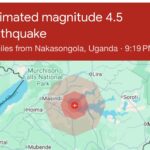


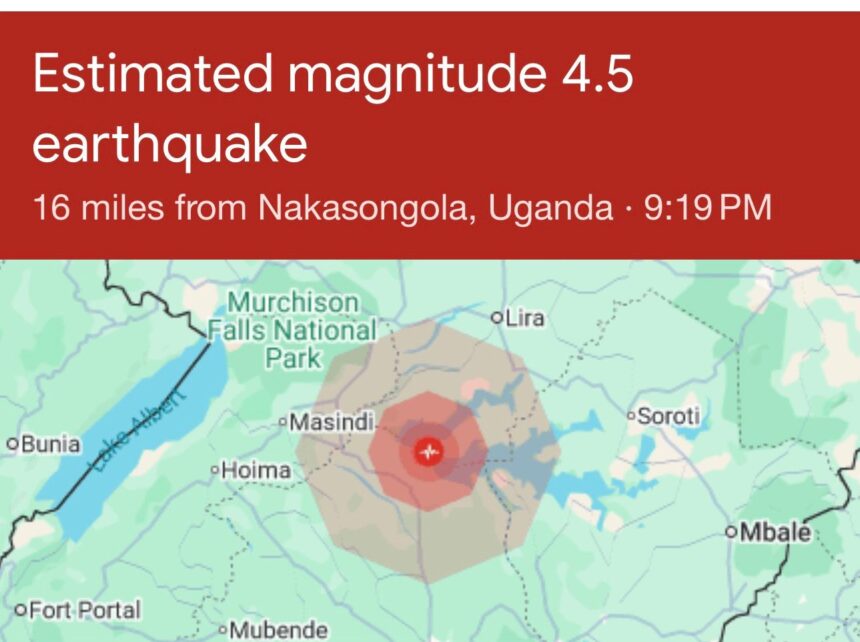
A 4.6 magnitude earthquake struck Nakasongola District in Uganda’s Central Region in the early hours of [today’s date], sending residents running into the streets as buildings shook for several seconds.
The Uganda Department of Geological Survey and Mines confirmed the tremor occurred at approximately EAT, with an epicenter located 12km northeast of Nakasongola Town Council. The quake registered at a depth of 10km, classifying it as a shallow earthquake capable of producing noticeable surface shaking.
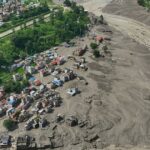
Residents in Nakasongola Town, Lwampanga sub-county, and areas along the Kampala-Gulu highway reported furniture moving, cracks appearing in walls of mud-and-wattle structures, and livestock becoming agitated. No deaths or serious injuries have been confirmed by district officials as of 7:00am EAT. Medical teams at Nakasongola Health Centre IV were on standby but reported no earthquake-related casualties.
“People woke up confused. The house was shaking and we thought it was wind,” said Sarah Nakato, a trader in Nakasongola Market. “We ran outside and stayed there for about 10 minutes before going back in.”
Nakasongola sits near the Nakasongola Discontinuity, a major geological suture between southern and northern crustal blocks in Central Uganda. The district is classified as “Medium” earthquake hazard by international hazard mapping agencies due to its proximity to faults linked to the East African Rift System.
Uganda’s location between the eastern and western arms of the East African Rift makes it prone to seismic activity. While most earthquakes are below magnitude 3, the country averages 7.5 quakes per year and has recorded at least 11 quakes above magnitude 5 since 2000. The 1966 Toro earthquake, magnitude 6.6, killed 104 people in Uganda and remains the deadliest in national history.
District Disaster Officer Richard Ssebuguzi said teams were assessing structural damage in schools and health facilities. “We are moving around to check for cracks in public buildings. So far, damage appears minimal but we are telling people to stay alert for aftershocks,” he said.
The Ministry of Energy and Mineral Development operates seismic monitoring stations at Entebbe, Hoima, Nakauka, Kilembe and Mbarara-Kyahi. Data from those stations will be used to determine if the Nakasongola tremor is part of a swarm.
This comes months after Uganda launched the SERENE project with the Global Earthquake Model Foundation in April 2026. The project aims to strengthen building codes and produce the country’s first national seismic risk map to guide construction in quake-prone areas.
Residents have been urged to avoid entering buildings with visible cracks and to prepare emergency kits. Aftershocks are common after shallow quakes in the Rift Valley and can occur hours or days later.
NNAfrica will update as more details emerge from government assessments.
Email Us on editorial@nnafrica.com