


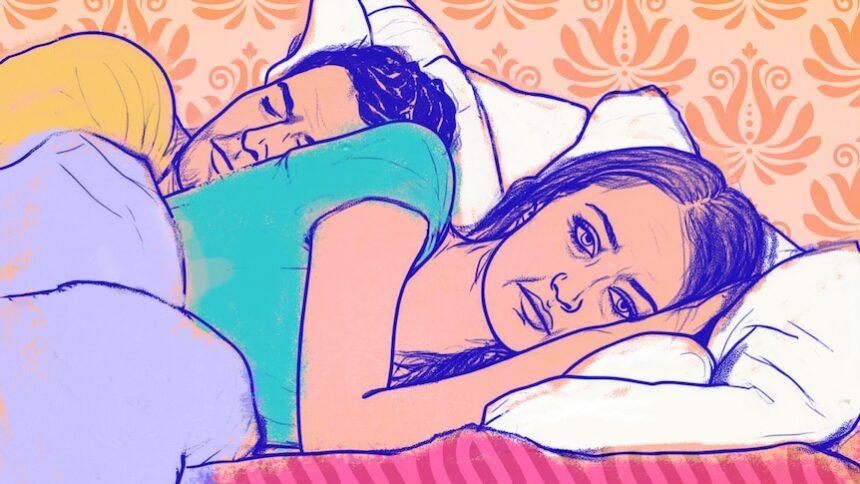
Waking at 3am with racing thoughts? So busy during the day you can’t unwind at night? Getting to bed early but still always tired?
While studies show on average women tend to sleep for longer than men — by about 20 minutes — they consistently report poorer sleep quality and feeling tired, explains Amelia Scott, a research fellow and clinical psychologist at Macquarie University who specialises in insomnia and sleep disorders.
There are biological and psychological reasons for this, but she explains the mental load is another powerful yet less obvious contributor to the gender sleep gap.
One study refers to the bedroom as the “invisible workplace” for women, where sleep is disrupted by child care and family obligations, but also hindered by mental load exhaustion.
The link between gender equality and sleep
Leah Ruppanner is a senior lecturer in sociology at The University of Melbourne and has researched the link between gender equality and sleep.
She says women are more likely to have their sleep disrupted by children and family duties, while men are kept up worrying about work and finances.
Her research comparing 23 European countries found in gender-equal societies such as Norway, women sleep better because there is a more equal divisions of housework and men take a more active role in child care.
But men are more rested in these circumstances, too, because women are more “work-empowered” and sharing the financial burden also.
“Men and women sleep better when women hold more power,” Dr Ruppaner says.
“There’s an incentive to get more women into government, give women more access to money, higher education, more full-time employment, more economic independence. Because actually the result of that is it takes some of the pressure off men.”
Women technically sleeping longer, but not better
Well-conducted studies usually show women sleep about 20 minutes more than men, says Dr Scott.
So why do many report they are tired and dissatisfied with their sleep?
She says the gender divide on sleep begins during puberty, and spikes again during pregnancy, after birth and during perimenopause due to fluctuating hormone levels.
Some health conditions such as thyroid disorders and iron deficiency can also play a part in women’s sleep health.
Women are at much higher risk of depression, anxiety and trauma-related disorders, which often accompany sleep problems and fatigue, Dr Scott says.
And disrupted sleep leaves women worse off mentally and physically.
“The link between poor sleep and poor mental health is indisputable,” Dr Scott says.
“When we’re not getting enough sleep, or not sleeping well, we are less able to regulate emotions the next day.
“It’s harder to do things that are good for you and harder to say no to things that are bad for you.”
How the mental load affects women’s sleep
When delving into how the mental load is playing a role in poor sleep, there are several layers.
Lack of time
“We carry these huge invisible loads, which objectively means we don’t have enough time for sleep,” says Dr Scott, with more of our time spent caring for children and aging parents, “or staying up late to do admin like school forms”.
While many women manage to put enough time aside for sleep at night, their opportunities for daytime rest are often scarce, she says.
That puts a lot of pressure on sleep to deliver all the restoration women need.
“There are periods of life, like in postpartum, where sleep disruption is inevitable,” Dr Scott says.
“But we know if women are supported in the day to have space, get outside, have some downtime or a nap, they can cope with fragmented sleep much better.”
Night-time caregiving
The gender sleep gap often widens during postpartum, leading to fragmented sleep and greater night-time care burdens.
But even as children age, a gap remains.
“The way we structure our days with our kids means that when one kid gets up in the middle of the night and needs that person that soothes them, they’re going to go to that person who does that during the day, which if it is the mother, will be the mother,” Dr Ruppaner says.
Men generally view sleep as a way recover and prepare for work, she says, while female caregivers see the night as an extension of their daytime obligations to family members.
Mothers are also more likely than fathers to be the ones staying up late worrying about teenagers’ safety or waiting for children to return home, says Dr Ruppaner.

Feeling wired
Mothers are “bringing their mental load to bed and ruminating”, says Dr Ruppaner.
Basically, women are so wired, they’re struggling to fall asleep. They’re then waking up in the middle of the night thinking about appointments, play dates and meal planning.
Dr Scott says women aren’t quite regulated enough for sleep to be restorative and continuous.
“A lot of people who I see clinically will have cause and effect between a busy day and really struggling to unwind for sleep, and having night wakeups where stuff they didn’t process in the day taps them on the shoulder at 3am.”
Exhaustion
Carrying the burden of the mental load during the day is overall making women more tired, says Dr Ruppanner.
She says constantly switching between different responsibilities fragments your thinking, which is “going to burn you out and strain your brain”.
“Which then means you need more sleep to recover,” Dr Ruppaner says.
Can we close the gap?
To fix the gender sleep gap there would need to be “massive structural and economic reform”, says Dr Scott, which is also to say: you’re not the issue.
“There is something really valuable in encouraging people to be compassionate with themselves … their brains aren’t broken.”
But Dr Scott there are some things you can do to try to close the gap in your own home.
“All that invisible work, define it and make it visible.”
For example, catalogue the cognitive labour you do in the home and discuss it with your partner, so it can be more fairly divided.
“We don’t need a holiday or a yoga retreat, or even to go to classes or get massages. That can be just another thing to have to do — and costly.
“Replace scrolling time with 5 to 10 minutes of fresh air. It definitely helps with feeling more regulated.”
She says it can also be helpful to take the pressure off getting a “full night’s rest”.
“One of the first things we do [in clinic] is make sure they are not putting aside too much time for sleep.
“If you need about seven hours sleep on average, add about one hour of ‘buffering’ time [to get to sleep or account for wakes].
“Otherwise, you’re crashing out by 9:00pm, and awake at 4:00am because you may have had enough.”
When waking at 3:00am with racing thoughts, Dr Scott recommends “try to do something enjoyable and distracting — and reduce arousal.”
And if you’re really struggling with sleep, Dr Scott recommends seeking professional support.
Email Us on editorial@nnafrica.com