
Friday, 11 Sep 2026
  • My Feed
  • My Saves
  • History
  • Contact Us
Subscribe
The News Network Africa
  • Home
  • Opinion

    Political Turmoil in Ivory Coast: Main Opposition Leader Excluded from Electoral List.

    By
    Eric Mafundo

    Stanbic Black Pirates Thrash Rhinos Rugby Club 45 -10 to Go Top of the Table

    By
    Hayley Sky

    Iranian strikes on bases used by US caused $800m in damage, new analysis shows

    By
    Hayley Sky

    Unity in Vision: African Leaders Convene in Addis Ababa to Mobilize for Agenda2063.

    By
    Eric Mafundo

    Battling the Rising Waters: Botswana’s Flood Crisis and Presidential Response.

    By
    Eric Mafundo

    The Besigye Case:Implications for Uganda’s Opposition.

    By
    Eric Mafundo
  • Politics

    Reuters Africa: Unveiling the Untold Stories of the Continent

    By
    Hayley Sky
    Rising Tides: Women’s Rights Advocates Urge UN to Tackle Backlash Against Progress.

    Rising Tides: Women’s Rights Advocates Urge UN to Tackle Backlash Against Progress.

    By
    Eric Mafundo
    Video: Dzoka Uyamwe- come back to suckle: Africans facing racism, come back home

    Video: Dzoka Uyamwe- come back to suckle: Africans facing racism, come back home

    By
    nna
    Gabon’s Former President and Family Released After Two Years, Flew to Angola in a Surprise Move.

    Gabon’s Former President and Family Released After Two Years, Flew to Angola in a Surprise Move.

    By
    Eric Mafundo
    Hezbollah just restarted the fight that Israel was waiting to finish

    Hezbollah just restarted the fight that Israel was waiting to finish

    By
    Hayley Sky
    Wild Chimpanzees Demonstrate First Aid Skills in Uganda: A Breakthrough in Understanding Primate Behavior.

    Wild Chimpanzees Demonstrate First Aid Skills in Uganda: A Breakthrough in Understanding Primate Behavior.

    By
    Eric Mafundo
  • Business
    Tunisia’s Solar Ambitions: A Leap Forward with International Partnerships.

    Tunisia’s Solar Ambitions: A Leap Forward with International Partnerships.

    By
    Eric Mafundo
    PRIDE and Family Chaos: Saying sorry heals and mends friendships

    PRIDE and Family Chaos: Saying sorry heals and mends friendships

    By
    Kasomba Musa
    Caught in the Crossfire: Cameroonians Trapped Between Separatists and Soldiers.

    Caught in the Crossfire: Cameroonians Trapped Between Separatists and Soldiers.

    By
    Eric Mafundo
    Turbulence Ahead: The Unfolding Crisis in Sudan’s Civil War.

    Turbulence Ahead: The Unfolding Crisis in Sudan’s Civil War.

    By
    Eric Mafundo
    30 years on, South Africa still dismantling racism and apartheid’s legacy

    30 years on, South Africa still dismantling racism and apartheid’s legacy

    By
    K Allen
    Citrus Crisis: How Trump’s Tariffs Endanger 35,000 Jobs in South Africa’s Citrus Sector.

    Citrus Crisis: How Trump’s Tariffs Endanger 35,000 Jobs in South Africa’s Citrus Sector.

    By
    Eric Mafundo
  • Pages
    • Advertise with US

Archives

  • September 2026
  • August 2026
  • July 2026
  • June 2026
  • May 2026
  • April 2026
  • March 2026
  • February 2026
  • January 2026
  • December 2025
  • November 2025
  • October 2025
  • September 2025
  • August 2025
  • May 2025
  • April 2025
  • March 2025
  • February 2025
  • January 2025
  • December 2024

Categories

  • Agriculture
  • Business
  • Culture
  • Health
  • Lifestyle
  • Minerals
  • News
  • Opinion
  • Politics
  • Sports
  • Technology
  • Travel
  • Uganda
  • 🔥
  • News
  • Politics
  • Business
  • Lifestyle
  • Culture
  • Opinion
  • Travel
  • Uganda
  • Minerals
  • Health
Font ResizerAa
The News Network AfricaThe News Network Africa
  • My Saves
  • My Feed
  • History
  • Travel
  • Opinion
  • Politics
  • Health
  • Technology
  • News
Search
  • Pages
    • Home
    • Advertise with Us
  • Personalized
    • My Feed
    • My Saves
    • History
  • Categories
    • News
    • Business
    • Minerals
    • Culture
    • Opinion
    • Politics
    • Agriculture
    • Health
    • Technology
    • Travel
Have an existing account? Sign In
Follow US
© 2025 The News Network Africa. All Rights Reserved.
The News Network Africa > Blog > Culture > Lifestyle > Why has Ivory Coast’s national dish attieke become a global icon?
CultureLifestyleNews

Why has Ivory Coast’s national dish attieke become a global icon?

K Allen
Last updated: 27 January 2025 12:40
K Allen
Share
Why has Ivory Coast’s national dish attieke become a global icon?
SHARE

Rumour has it that some Ivorians can eat attieke morning, afternoon and night.

Contents
Why was attieke recognised?What’s attieke’s origin and its traditional significance?How is attieke made?What are the controversies surrounding attieke?What other African dishes have UNESCO heritage status?

The fermented cassava meal has long been a marker of national identity in Ivory Coast, beloved across all levels of society in the West African nation. And now, the United Nations has secured attieke’s status as one of the region’s most important servings.

- Advertisement -

In December, UNESCO (the United Nations Education, Scientific, and Cultural Organisation) recognised attieke’s icon status by listing the dish as an intangible cultural heritage. That move elevates the tangy meal to the status of other globally renowned culinary favourites like South Korean kimchi and Mexican tacos.

For Ivorian women who’ve prepared the dish in vast amounts for sale, and who have passed down the intensive cooking skill over generations, attieke is also a way to bond and a path to financial freedom.

- Advertisement -

Pronounced “at-chie-kay”, the meal is sometimes called Ivorian couscous and has been marketed by some as a gluten-free alternative to regular couscous.

Now, with the UNESCO recognition, its branding could receive a new boost. But what are the origins of attieke, why do Ivorians love it so much, and how does one prepare the dish?

Why was attieke recognised?

A UNESCO panel added tangy attieke to the organisation’s list of intangible cultural heritage on December 5 at the body’s 19th session on safeguarding non-physical heritage in Asuncion, Paraguay. The list highlights culturally significant practices, knowledge, or expressions that are particular to a region or country.

- Advertisement -

Alongside the Ivorian dish, UNESCO recognised 10 other cultural meals or drinks, including Japanese sake, a traditional rice wine; and Caribbean cassava bread eaten by Indigenous communities.

In considering attieke, UNESCO noted the skills related to its production. “The knowledge and skills are passed down orally and through observation within families … The related knowledge and skills play an important role in the social life of communities,” it said.

Attieke’s intense, multiple-day preparation methods have been passed down over generations in Ivory Coast as women often organise themselves into local production businesses and produce it in big batches.

Ramata Ly-Bakayoko, Ivory Coast’s delegate to UNESCO, said at the session in Paraguay that the meal was based on “precise gestures and traditional techniques that have lasted for centuries” and that it is “deeply rooted” in life and culture.

What’s attieke’s origin and its traditional significance?

Attieke is an accessible and affordable dish that has become a staple in family meals, UNESCO noted. It is also often served at weddings, birthdays, or other events, with a side of spicy pepper sauce, grilled or fried tilapia fish, and chopped onions.

The dish is typically prepared by women in the southern lagoon parts of the Ivory Coast, especially from the Adioukrou, Avikam and Ebrie groups. In fact, the name stemmed from the Ebrie term for the meal: “adjeke”.

In more recent decades, production has spread across the country, and demand for attieke is growing in neighbouring countries like Burkina Faso, Ghana and in African diasporas across Europe and North America.

Producers are increasingly exporting a pre-cooked form of the meal that can be easily prepared at home. Countries like Burkina Faso are also seeing attieke producers.

How is attieke made?

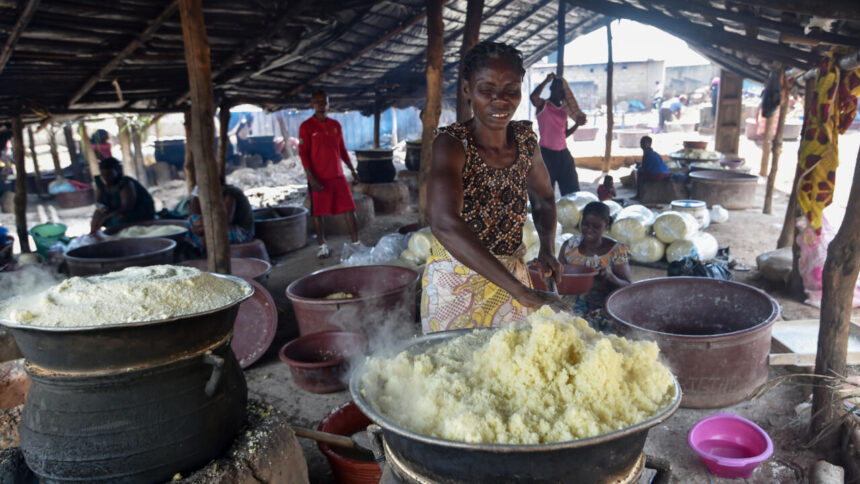
The steaming fermented cassava pulp often takes three to five days to make from scratch.

Usually, groups of women gather to make the meal in huge batches and then portion and sell it to market vendors in small plastic bags.

Magnan, a days-long fermentation process, gives attieke its distinctive twinge. Here’s how the meal is made traditionally (plus easy alternatives for single-home cooking):

  • First, slightly boiled or braised cassava roots are soaked for one to three days to ferment and act as yeast in the final product.
  • Then, more fresh roots are peeled, cut, and washed. Together with the fermented roots, some overheated palm oil, and some water, the mixture is then crushed in a grinder. The ice crush option on a home-use blender would achieve similar results.
  • Afterwards, the pulp is portioned into plastic bags and left for about 12 to 15 hours to ferment further.
  • Next, the fermented paste is thoroughly squeezed to get the water out. Typically, Ivorian women prepare the meal in batches using an industrial press. For home use, placing the paste in a sieve cloth or bag, putting a flat board on it, and then placing heavy objects like stones on it for hours could achieve similar results.
  • Then, the drying paste is sieved, usually with a 5mm sieve to get out the chaff. Ivorian women then use their hands to fluff up the paste so granules form better.
  • The dried paste is thereafter spread out in thin layers on tarps and laid out in the sun to dry. That process takes about half an hour or more, depending on the weather. At home, an oven would do the job.
  • Again, the now fully-dried granules are sieved and fluffed to remove any fibres or other material.
  • Next, the granules are steamed – rather than cooked – in traditional pots designed to hold hot water beneath the dried attieke. At home, a metal sieve lined with some cloth and placed inside a pot with hot water could do. Steaming takes 30 to 40 minutes.
  • Finally, the finished product, soft and fluffy in consistency, is typically packed into small plastic bags for sale in markets.

What are the controversies surrounding attieke?

Many Ivorians are passionately territorial about attieke. Some see increasing levels of production in neighbouring countries as a threat to national identity.

In 2019, there was outrage on Ivorian social media platforms after a Burkinabe chef and entrepreneur, Florence Bassono, founder of Faso Attieke, won an award at an agricultural and animal resources fair in Abidjan. Many Ivorians were angered that a non-Ivorian national won the competition over local entrepreneurs.

In December, following UNESCO’s recognition of the meal, locals told a Radio France International (RFI) reporter that the global recognition was important and would help Ivorian attieke stand out.

“We often hear that Burkina Faso is first or China is first in attieke production, and we who created attieke are last,” one local in Abidjan’s Anono suburb told the reporter.

In 2019, the Ivorian government began a bid to trademark the name, “Attieke des Lagunes” or “Attieke of the Lagoons”, and its intensive preparation methods, in order to protect its authenticity.

In mid-2023, the African Intellectual Property Organisation (OAPI), which includes 17 French-speaking African nations, certified Ivorian attieke and its production methods by granting it PGI or “Protected Geographical Indication” status. That label highlights attieke’s special cultural link to Ivory Coast and distinguishes it from products made in other countries.

What other African dishes have UNESCO heritage status?

With its new status, attieke joins the Senegalese rice dish, thiebou dieune – the only other sub-Saharan African dish recognised with the UNESCO honour.

Originating from the northern city of Saint Louis, the meal, pronounced chee-buu-jen, is prepared with fish and vegetables and is often eaten for lunch or dinner. In the dominant Wolof language, it literally means “rice and fish”.

UNESCO recognised the dish in 2021, along with the rumba dance from the Democratic Republic of the Congo (DRC). Kenya’s Isikuti dance was also inscribed on the list in 2021.

Email Us on editorial@nnafrica.com

TAGGED:african food
SOURCES:aljazeera.com
Share This Article
Facebook Whatsapp Whatsapp Telegram Email Copy Link
Previous Article UN chief calls for Rwandan forces to leave DRC as rebels press offensive UN chief calls for Rwandan forces to leave DRC as rebels press offensive
Next Article The Rolex – A Ugandan cuisine once ranked No.1 by CNN The Rolex – A Ugandan cuisine once ranked No.1 by CNN

Latest Posts

Paratus Group puts East Africa connectivity in focus at ITW Africa 2026
Business News
The Kebu: Uganda’s Lesser-Known Community and a Heritage Worth Preserving
Culture Uganda
The Aringa: The West Nile People with a Rich Cultural Heritage
Culture Uganda
Uzbekistan Deepens Interest in African Markets as Trade and Investment Ties Grow
Business

Opinions

Social interaction is essential for healthy childhood development
News Opinion
PRIDE and Family Chaos: Saying sorry heals and mends friendships
Lifestyle Opinion
The Tongue, the main reason for divorce today
Lifestyle Opinion
Constitutions must serve citizens, not political power
Opinion

You Might Also Like

Africa at the 2026 FIFA World Cup: Can This Be the Year History Is Made?
News

Africa at the 2026 FIFA World Cup: Can This Be the Year History Is Made?

By
Hayley Sky
Tensions Rise: Why South Sudan’s Vice President Found Himself Surrounded by the Army and Allies.
News

Tensions Rise: Why South Sudan’s Vice President Found Himself Surrounded by the Army and Allies.

By
Eric Mafundo
UN rights chief warns worst may be ahead in east Congo conflict
NewsPolitics

UN rights chief warns worst may be ahead in east Congo conflict

By
Hayley Sky
Nigerian Senator Natasha Akpoti Learns of Government Lawsuit Through the News: A Wake-Up Call on Transparency and Due Process.
News

Nigerian Senator Natasha Akpoti Learns of Government Lawsuit Through the News: A Wake-Up Call on Transparency and Due Process.

By
Eric Mafundo
The News Network Africa
X-twitter Facebook Rss

About US


The News Network Africa: Your instant connection to breaking stories and live updates. Stay informed with our real-time coverage across minerals, culture, politics, business, tech, entertainment, and more. Your reliable source for 24/7 news.

Top Categories
  • News
  • Opinion
  • Politics
  • Tech
  • Health
  • Travel
Usefull Links
  • Advertise with Us
  • Complaint
  • Privacy Policy
  • Cookie Policy
  • Submit a Tip

© The News Network Africa. All Rights Reserved.

Welcome Back!

Sign in to your account

Username or Email Address
Password

Lost your password?