

As global leaders gather in Ulaanbaatar, Mongolia, for the 17th session of the Conference of the Parties (COP17) to the UN Convention to Combat Desertification (UNCCD), a quiet human tragedy is unfolding in north-eastern Uganda. While diplomats debate climate policy in air-conditioned comfort, the families of the Karamoja sub-region are facing a harsh, dusty reality that demands immediate action. Under the global banner of “Restoring Land. Restoring Hope,” delegates are busy negotiating text-based commitments. But on the ground, hope cannot be eaten. The real solutions require translating these abstract discussions on drought, finance, and governance into direct, local investments that save actual human lives.
This high-level global discussions leave room for the brutal reality of Karamoja’s environmental collapse. Driven by prolonged dry spells that have resulted in estimated crop losses of 50–70% of the total harvest, 473,000 people are currently facing acute food insecurity at Crisis level or worse. To put a human face on this crisis, the Integrated Food Security Phase Classification (IPC) reports that 432,000 people are in Crisis, with another 41,000 trapped in Emergency conditions. Worse still, approximately 122,100 children aged 6–59 months are expected to suffer from acute malnutrition and require treatment between March 2026 and February 2027, including 30,600 cases of severe acute malnutrition. These are not just statistics, they are a plain reminder of the total disconnect between bureaucratic planning and ground-level survival.
This clearly show cases the disconnect clearly in how relief is being handled. The government has launched a relief operation targeting 313,987 households across 480 parishes in all nine districts of Karamoja. More than 9.4 million kilograms of maize flour and dry beans are being distributed. Yet emergency food relief, while necessary, cannot by itself address a crisis driven by prolonged drought, poor harvests, water stress, livestock losses and environmental degradation. In a region where livelihoods depend heavily on land, water and livestock, relief must be matched with investments that enable communities to withstand the next climate shock.
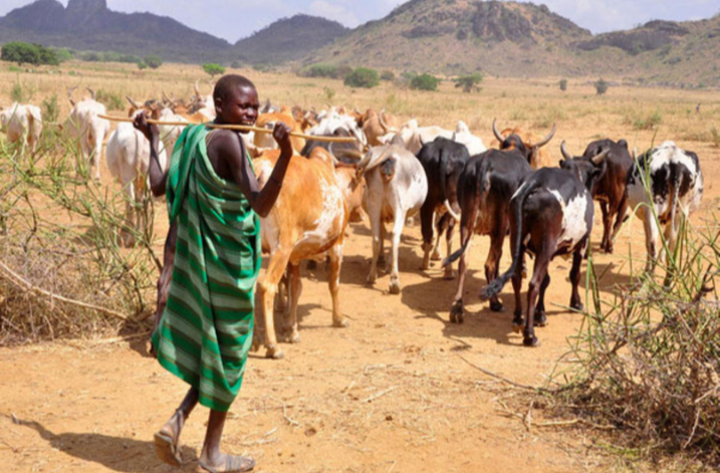
When these relief efforts fail, the resulting environmental degradation triggers a destructive domino effect across the entire community. Karamoja’s parched rangelands and dry conservation pools have placed further pressure on already fragile ecosystems and the communities and livelihoods that depend on them. This ecological destruction quickly spills into a wider livelihood and security crisis. Left with no options, vulnerable community members can be pushed toward harmful coping mechanisms, including pressure on wildlife and natural resources, just to survive. Moreover, despite the global focus of the International Year of Rangelands and Pastoralists (IYRP 2026), rigid administrative boundaries and weak protection of customary pastoral systems risk undermining the mobility and resource access on which pastoral livelihoods depend. Rangelands cover about half of the world’s land surface and support pastoral communities whose livelihoods are closely connected to ecosystem health.
To stop this downward spiral, the Office of the Prime Minister (OPM) and the Ministry of Water and Environment must immediately pivot away from temporary grain drop-offs and look toward community-led resilience. True reform means embracing sustainable finance, a theme championed locally by civil society organizations to target the root causes of degradation. This means investing heavily in systemic water infrastructure like valley dams and solar-powered irrigation to protect crops and livestock.
It also means empowering traditional Karimojong institutions to manage their rangelands using indigenous knowledge, ensuring that mining corporations extracting Karamoja’s gold, limestone, and granite contribute fairly to local development and that communities can meaningfully benefit from the revenues and agreements connected to extraction. Finally, push for the promotion of eco-friendly livelihoods like sustainable honey production and gum arabic harvesting to provide financial resilience without exploiting wildlife.
Ultimately, Uganda’s delegation must use Karamoja as a live case study at COP17 to demand localized, flexible climate finance. While back at home, Parliament must urgently strengthen laws and policies that protect pastoral land rights from aggressive extraction and prioritize water security in arid zones. Karamoja’s hunger crisis proves that land degradation is a direct catalyst for poverty, conflict, and insecurity. Therefore, true environmental governance requires replacing boardroom assumptions with real-world, localized actions that restore both the land and the dignity of the people who depend on it.
By Elizabeth Kulume,
Environment Governance Institute.
Email Us on editorial@nnafrica.com