


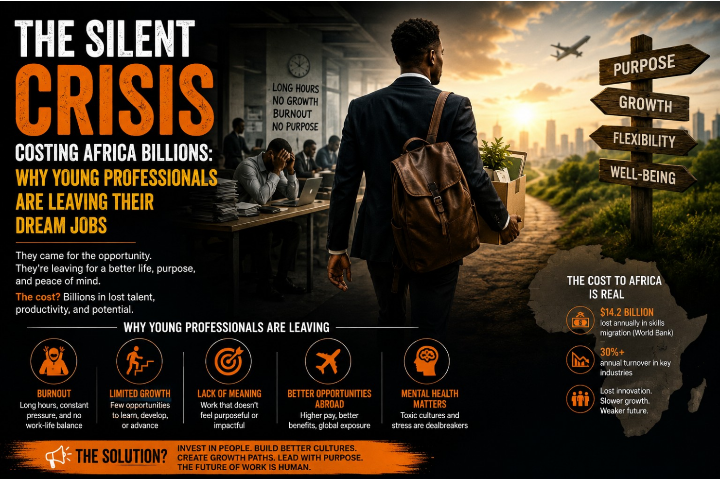
Across Africa, a growing number of young professionals are walking away from jobs that once represented success, stability, and ambition. From banking halls in Lagos to tech startups in Nairobi and corporate offices in Johannesburg, employers are facing an unexpected challenge: retaining talented young workers.
What appears to be a personal career decision is becoming a broader economic issue. High turnover, talent shortages, and declining employee engagement are costing organizations—and economies—billions of dollars in lost productivity and recruitment expenses.
The End of the “Dream Job” Era
For previous generations, landing a prestigious corporate role was often considered the ultimate career achievement. A good salary, job security, and social status were enough to keep employees committed for years.
Today’s young professionals view work differently.
Many are no longer willing to sacrifice their mental health, personal growth, or work-life balance in exchange for a paycheck. Instead, they are evaluating careers through a broader lens that includes purpose, flexibility, learning opportunities, and overall well-being.
As a result, jobs that once seemed highly desirable are losing their appeal.
Why Young Professionals Are Leaving
1. Burnout Is Becoming the Norm
Many young employees report working longer hours than ever before, often without proportional compensation or recognition.
The rise of digital communication has blurred the boundaries between work and personal life. Emails, messages, and deadlines follow employees home, creating constant pressure and increasing the risk of burnout.
When exhaustion becomes a permanent state rather than a temporary challenge, many workers choose to leave.
2. Limited Career Growth
Young professionals are ambitious. They want to learn, develop new skills, and see clear pathways for advancement.
When organizations fail to provide meaningful development opportunities, employees begin searching elsewhere. A higher salary may attract talent, but a lack of growth opportunities often pushes them away.
3. The Search for Meaning
Increasingly, employees want their work to contribute to something larger than profits.
Young workers are asking important questions:
- Does my work create value?
- Am I making an impact?
- Does this organization align with my values?
Companies that cannot answer these questions convincingly may struggle to retain top talent.
4. Better Opportunities Abroad
Africa continues to experience significant talent migration.
Highly skilled professionals in technology, healthcare, finance, and engineering are being recruited by international employers offering competitive salaries, remote work options, and stronger career progression.
For many, leaving a local employer is not simply about earning more—it’s about accessing opportunities they feel are unavailable at home.
5. Mental Health Is No Longer Ignored
A growing awareness of mental health has changed workplace expectations.
Young professionals are less willing to tolerate toxic environments, poor leadership, workplace bullying, or unrealistic workloads. Rather than enduring unhealthy conditions, many are choosing to resign and prioritize their well-being.
The Economic Cost
The departure of skilled employees creates significant costs for businesses:
- Recruitment and onboarding expenses
- Loss of institutional knowledge
- Reduced productivity
- Project delays
- Lower team morale
At a national level, the impact is even greater. When talented professionals leave industries—or countries altogether—economic growth slows, innovation suffers, and organizations struggle to remain competitive.
This creates a cycle where talent shortages become increasingly difficult to address.
What Employers Must Do
Organizations that want to retain young professionals must rethink traditional workplace models.
Key priorities include:
- Offering clear career development pathways
- Investing in employee well-being
- Providing flexible work arrangements where possible
- Building inclusive and supportive workplace cultures
- Ensuring fair compensation and recognition
- Connecting employees’ work to a meaningful mission
Retention is no longer just an HR issue; it is a strategic business priority.
A Wake-Up Call for Africa
Africa possesses one of the world’s youngest and fastest-growing workforces. This demographic advantage could drive decades of economic growth and innovation.
However, if organizations fail to adapt to the evolving expectations of young professionals, they risk losing the very talent needed to fuel that future.
The silent crisis is not simply that employees are leaving their jobs. It is that many are leaving jobs they once dreamed of having. Understanding why—and responding effectively—may determine which organizations thrive in the years ahead and which are left behind.
Email Us on editorial@nnafrica.com