


He told his village he would build their school from mud. They laughed.
What followed would quietly reshape the global architectural conversation.
Today, Francis Kéré is celebrated as one of the most important architects of our time, becoming the first African to win the Pritzker Architecture Prize; often described as architecture’s Nobel Prize. But long before global recognition, his work was rooted in something far simpler: the earth beneath his feet.
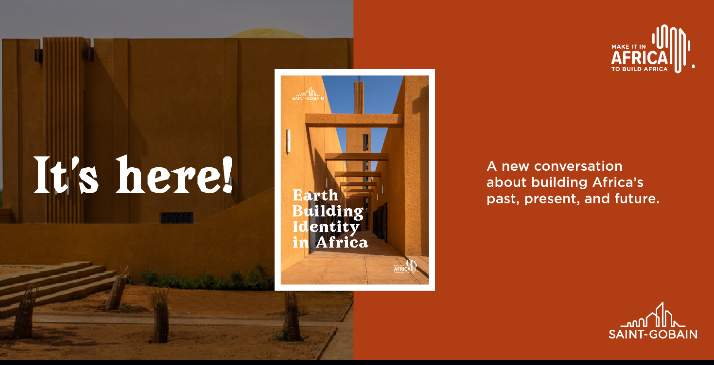
Earth Building Identity in Africa is not a technical document but rather a cultural exploration. Drawing on voices from across the continent, it captures a living architectural tradition that has, for generations, existed quietly in villages, landscapes, and inherited knowledge systems.
“True innovation can only thrive when it is rooted in the recognition of our heritage,” writes Melissa Nsabimana, Marketing and Communications Director at Saint-Gobain Africa, authors of Earth Building Identity in Africa.
Across Africa, earth has shaped homes, communities, and ways of life often without formal recognition. Passed down through practice rather than textbooks, these building methods reflect an intuitive understanding of climate, material, and place. Yet for decades, this knowledge has been marginalised.
Faced with climate change, rising construction costs, and the environmental toll of industrial materials, architects and designers are looking again at what has always been available.
Earth, it turns out, is not only viable, but visionary.
At its core, earth architecture is climate responsive. Thick earthen walls regulate temperature naturally, absorbing heat during the day and releasing it slowly at night. Structures “breathe”, managing humidity and airflow without mechanical systems.
Mariam Issoufou’s Hikma Complex in Dandaji stands as a powerful example of climate-responsive design in practice. Built with locally sourced compressed earth and designed around shaded courtyards and perforated façades, the structure allows heat to dissipate while promoting natural airflow and filtered light. No reliance on mechanical cooling, just architecture working in harmony with local climate, materials, and community needs.
In a South African context, where energy insecurity and extreme weather are becoming part of daily life, these principles feel less like tradition, and more like necessity. But to reduce earth to its technical performance is to miss its deeper significance.
As the publication explores, building with earth is also about identity. It is about reconnecting with local materials, local skills, and local narratives, reclaiming ways of building that are inherently tied to place. It is, in many ways, a quiet reimagining of what progress looks like.
Across the continent, architects are blending vernacular techniques with contemporary design, creating spaces that are both modern and deeply rooted. From rammed earth walls to compressed earth blocks, these approaches are as diverse as the cultures they emerge from.
And in doing so, they are challenging long-held assumptions about what African architecture can and should be.
There is also an urgency to this return. The construction industry remains one of the largest contributors to global carbon emissions. As African cities expand, the materials and methods chosen today will define not only skylines, but environmental impact.
Earth offers an alternative path. One that is low-carbon, locally sourced, and inherently circular. Buildings can be repaired, adapted, or returned to the land, reducing waste and extending their lifecycle.
It also opens doors for economic inclusion, supporting local artisans, creating jobs, and nurturing skills that are both traditional and forward-looking.
Still, the path forward is not without tension. Modern aspirations, perceptions of status, and the drive toward globalised aesthetics continue to influence how people build and live. At the same time, the growing popularity of “sustainable” materials raises important questions, not about their value, but about how they are defined, applied, and understood in different contexts.
What does it mean to build responsibly? And who defines what is considered modern?
In this context, Earth Building Identity in Africa does not offer fixed answers. Instead, it creates space for reflection, encouraging dialogue between past and present, tradition and innovation. Ultimately, the book is an invitation. An invitation to look again at what has been overlooked. To value what has been inherited. And to imagine a future where architecture is not imposed but emerges naturally from its environment.
Email Us on editorial@nnafrica.com