

During a crisis like what is now unfolding in the Middle East, a president receives a net assessment prepared from intelligence and military sources. It might evaluate the balance of forces, leadership dynamics and strategic calculations — without making policy recommendations. Its purpose is clarity: a baseline from which decisions can be made.
We do not have access to the stream of reporting flowing into the Situation Room. But enough is visible to construct a disciplined baseline assessment.
Here are the ten issues that matter most — and what to watch next.
1. Air dominance over Iran
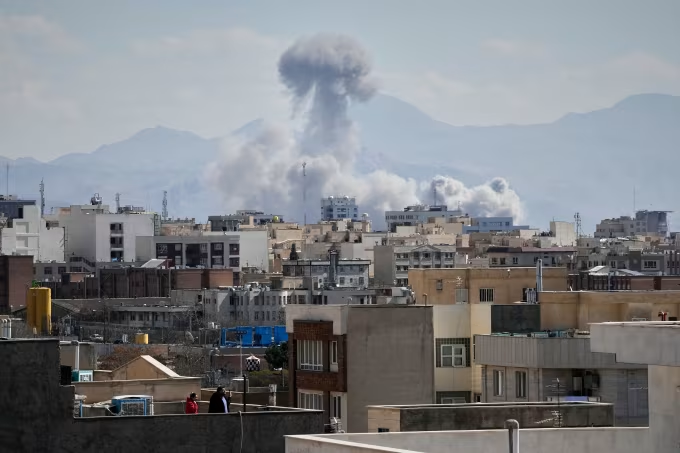
In the early hours Saturday night, US military forces reportedly destroyed whatever was left of Iran’s air defenses. There was not much there as much of Iran’s Russian supplied systems were destroyed in previous strikes by Israel over the last year.
The American and Israel sides now appear to have air dominance over Iran. That means U.S. and Israeli aircraft can fly at will with manageable risk for as long as this conflict continues—and afterwards.
2. Iranian leadership disarray
Trump has reported that 48 top Iranian leaders were killed in the initial hours of the air campaign, including Iran’s Supreme Leader, Ali Khamenei. This would be the equivalent of the American president, chairman of the Joint Chiefs, and multiple Cabinet officials killed in a moment
For a country like Iran that has only had one leader succession since its 1979 civil war, this is likely to cause deep disarray and uncertainty throughout Iran’s chain of command. On Sunday, Iran’s foreign minister acknowledged in an interview that its military units are likely acting independently and out of contact with a chain of command above them.
That’s an acknowledgment that even Iranian officials may be unsure who’s in charge.
3. Succession uncertainty
Iran’s regime has sought to reassure its followers that a succession to replace Khamenei is underway, with a process outlined in its constitution. This means an interim council led by its president, chief justice, and a cleric to be named is purportedly making decisions, But none have been seen publicly, and Israeli and US aircraft are continuing to target Iran’s leadership. A strike was reported Saturday in the vicinity of where former Iranian President Mahmoud Ahmadinejad is said to live.
Also, there is no clear successor to Khamenei. One top candidate, another former president, Ebrahim Raisi, died in a helicopter crash two years ago. Another, Khamenei’s son, Mojtaba, would face several hurdles despite his strong links with the Islamic Revolutionary Guard Corps. Absent a named successor, the foundation of Iran’s Islamic republic may further erode over the coming weeks.
4. Missile math
Iran is responding to the American and Israeli blows with missile attacks into Israel, American facilities in the region, and civilian targets across the Gulf. The top priority for US and Israeli military commanders in these early days is to degrade Iran’s missile capabilities — particularly its launchers. The launchers determine how many missiles Iran can fire per salvo. This will be difficult. Iran has limited quantities of longer-range missiles to reach Israel, but it has larger stockpiles of short- and medium-range missiles for closer range targets, such as in Iraq or the Gulf states. They are also likely dispersed and hidden before use.
Over the coming days, I’ll be watching to see whether Iran can sustain the barrages we’ve seen in early hours, or whether military strikes into Iran are having the desired degradation effect.
5. Gulf states: Off the sidelines
The most surprising development for me in these early hours has been Iran’s decision to target civilian infrastructure, hotels, and residences in the Gulf states — Saudi Arabia, UAE, Qatar, Bahrain, Kuwait, and Oman. US Central Command on Sunday put out a list of what’s been targeted, after Iran claimed to be focused solely on American military bases.
These countries wanted to remain out of this conflict, but Iran’s attacks are now drawing them in. Political disagreements have been put aside in the face of a common threat. Now, there is consideration of how to respond. Should some of the Gulf states join strikes into Iran, that would be a significant development, reversing years of work by Iran to reconcile with its Arab neighbors.
Note: The UK, France, and Germany on Sunday issued a joint statement saying they might also join in strikes against Iran’s missile and drone supplies. This indicates a possible coalition emerging against Iran.
By late Sunday, a broader coalition appeared to be forming. Following the E3, five Gulf states and Jordan joined the US in condemning Iran and asserting their “right to self defense” against Iran’s attacks.
6. Russia and China — absent for now
Iran historically has touted its strategic partnership with Russia and China. Its provided missiles and drones for Russia to use in Ukraine, and had relied on Russian air defense systems. Those are now destroyed and Russia has no capacity to replace them. As for China, it depends on cheap Iranian oil (80% of Iran’s oil goes to China) as well as global trade through the Strait of Hormuz.
Moscow and Beijing have said little even after the death of their partner, Khamenei. Late Sunday, a reported phone call between the foreign ministers of Russia and China offered verbal condemnation of the American and Israeli strikes, but not much else. That’s unlikely to change. Iran is standing on its own.
7. No major asymmetric response — yet
Iran’s asymmetric toolkit — cyber operations, proxy militias, maritime disruption — appears dormant thus far. Iranian officials backed off threats to close the Strait of Hormuz, and US forces are reportedly targeting Iran’s navy. Iran’s crown jewel proxy, Hezbollah, is already battered and thus far not engaged on Iran’s northern border. Militias in Iraq have fired drones at the airport in Erbil, but Iraqi leaders are working to keep its country out of the crosshairs. Nonetheless, this is an area to watch, as lack of action may reflect disarray — or preparation.
8. Energy shock
Any sustained conflict involving Iran raises oil prices — especially if maritime traffic through the Strait of Hormuz is threatened. That is certain whether Iran acts to shut down the strait or not. On Sunday, OPEC, the oil producing countries led by Saudi Arabia, agreed to increase production by more than 200 thousand barrels per day. Still, oil prices rose 10% as markets opened on Sunday evening.
Traders will be watching markets closely over the coming days. Iran will hope that a price boost raises domestic pressure on Trump, who’s aimed to keep prices low.
However, global markets have changed since the days of Middle East energy crises decades ago. The United States is now the largest producer in the world, and any significant global price disruption from Middle East exports is likely to be short lived.
9. Escalation dominance — not outcome dominance
Militarily, the United States maintains overwhelming conventional superiority: airpower, naval strike groups, global intelligence reach and logistics depth. If Iran chooses to significantly escalate, the US together with Israel retain multiple options and targets across Iran. That advantage over time might shape Iranian calculations and support more pragmatic voices in the leadership transition.
Military advantage alone, however, cannot deliver political outcomes and it’s probable at this stage that Iran’s new leaders remain committed to its ideology of revolution and hostility towards the West.
10. No natural endpoint
Wars, once begun, carry their own momentum with variables often not considered at the outset. It is impossible to predict 48 hours in where this is all leading. The main concern at this stage from Washington’s vantage point — even after the extraordinary military success — is that there’s no clear offramp or natural endpoint to the campaign. Even in the best case of an Iranian uprising against what’s left of the regime, those remnants will likely act to suppress protests once again with lethal force. It’s an open question whether the United States would then use air power to deter another crackdown. Those are the questions that must be considered — now.
Bottom line
Strategic and tactical advantage can coexist with profound uncertainty about where this all leads. That is likely the net assessment Trump is receiving.
Email Us on editorial@nnafrica.com