

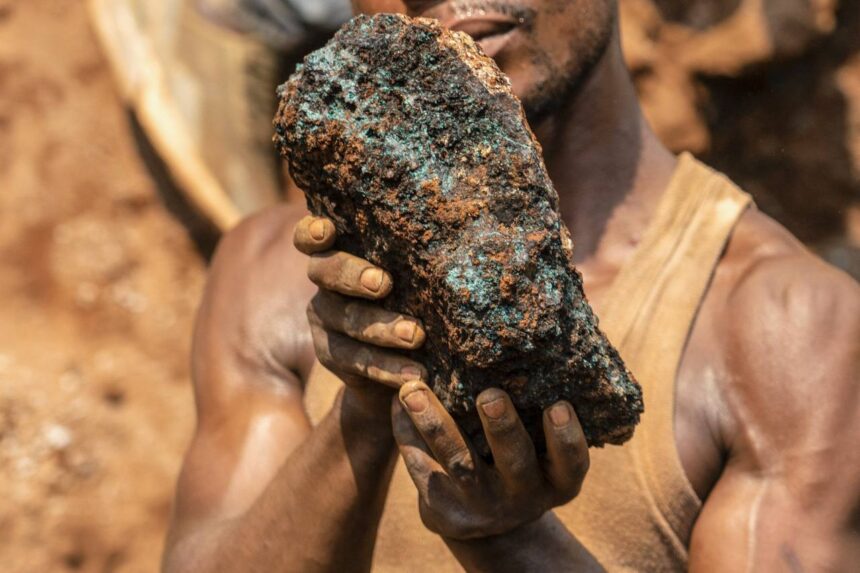
Goma, Democratic Republic of the Congo – In cities in the mineral-rich eastern Democratic Republic of the Congo (DRC), home to some of the world’s largest cobalt and copper reserves, eyes are on the outcome of a meeting happening thousands of kilometres away.
In Washington, DC, on Wednesday, United States Secretary of State Marco Rubio will host the inaugural Critical Minerals Ministerial, where delegations from 50 countries including the DRC will discuss efforts to strengthen and diversify mineral supply chains as the US seeks to counter China’s global dominance in the sector.
As part of a “resources-for-security” type deal agreed last year, the US signed a mining agreement with Kinshasa’s government to secure supplies of components essential to its technological innovation, economic power, and national security.
While Congolese President Felix Tshisekedi has touted the economic benefits of the endeavour, many in the country’s mining epicentre – trapped between poverty and armed violence – see only further oppression on the horizon.
“We are exploited in mineral extraction,” said Gerard Buunda, an economics student in Goma, the capital of North Kivu province, which is a significant source of the world’s coltan, tin and gold resouces. “There are investors who make us work; sometimes they chase us off our land and force us to work for them in their mines for their own selfish interests.
“We don’t want to be exploited any more.”
Buunda, 28, who was born not far from the mineral-rich city of Rubaya, condemns what he says are foreign multinationals exposing people to poverty and low wages, child exploitation, and environmental degradation – putting Congolese lives at risk.
He fears that the Donald Trump administration’s voracity for critical minerals could heighten socio-political instability in many parts of the world.
“Here in eastern DRC, the people who finance mineral exploitation, when they find new mines, buy land from local communities in collusion with our leaders and displace them, and this is the root cause of insecurity,” said Buunda.
He called on African leaders, especially those in the DRC, to avoid being “the fall guys” and instead keep an eye on the future of their own rare earths.
‘They said: please come and take our minerals’
With large deposits of cobalt and lithium – which are essential for electric vehicle batteries and renewable technologies – the Congolese authorities are promoting the DRC as a solution for the energy transition.
The US has shown interest, including directly linking security guarantees to resource extraction when it mediated the signing of a peace deal between conflict-prone neighbours DRC and Rwanda last year.
“I actually stopped the war with Congo and Rwanda,” Trump claimed in December. “And they said to me, ‘Please, please, we would love you to come and take our minerals.’ Which we’ll do.”
Koko Buroko Gloire, a Congolese international affairs commentator based in Kenya, doubts the DRC will gain anything solid from the deal with the US. The market for critical minerals, he believes, is attracting the “covetousness” of major world powers who are lining up for an “increasingly geopolitical” battle.
But at the end of the day, for the DRC, Koko says the benefits – or lack of them – will depend on the will of the Congolese leadership.
“If this deal will allow us, the Congolese people, to have roads from point A to point B, to have clean water, to have hospitals, to have water, I think it’s a good deal,” he told Al Jazeera, urging Congolese leaders to make sure the DRC does not come out empty-handed.
Before Trump came to office, former US President Joe Biden visited the region, in part to discuss the Lobito Corridor railway infrastructure project, which is currently in disrepair in DRC but will connect the country’s mining provinces to Angola, along the Atlantic Coast – a key port for the export of minerals from Africa to the US.
According to satellite image analysis carried out by Global Witness, up to 6,500 people could be affected by displacement linked to the development of the Lobito corridor in the DRC.
The campaign group said it conducted interviews with different social groups last year in DRC’s Kolwezi, and also visited the railway tracks that will be cleared during the rehabilitation.
It said it had found that the railway line runs through vulnerable communities that have benefitted little from the mining boom in Kolwezi, highlighting a “complex” legal situation where the status of houses and buildings along the railway line was disputed, as was the size of the area to be cleared.
For Global Witness, the Lobito corridor will be a “litmus test” for Western partners who claim that the project represents a more equitable model for resource exploitation.
Local communities ‘negatively’ affected
Gentil Mulume, 35, is an activist in Goma, working on matters of transparency and good governance. He emphasises that the Washington meeting is not a dinner party but a call to demonstrate seriousness, particularly with regard to compliance with environmental standards, transparency in mining governance, and industrialisation.
He believes the importance of a mining agreement between the DRC and the US cannot be assessed solely in terms of its geopolitical or international economic significance.
“This type of agreement risks continuing structurally unbalanced partnerships in which the DRC remains a mere supplier of strategic raw materials for the benefit of Western powers,” he suggests.
John Katikomo, a Congolese environmental activist, says the foundations for a fair partnership between the DRC and the US are already off to a bad start, as the deal is “opaque” and authorities in Kinshasa have not disclosed details to citizens.
“Many people are misinformed, and there is poor distribution of resources in relation to these critical minerals. Will the population benefit from this?” he asked.
For Kuda Manjonjo, a Just Transition adviser with PowerShift Africa, a think tank based in Kenya, Africa holds a disproportionate share of the critical minerals essential to the energy transition, but remains marginalised in global value chains.
“This disparity reflects an unfair exploitation model that hinders local development,” he said, stressing the importance of rebalancing the situation, calling for fairer governance, local investment in mineral processing and transformation, and better African representation in strategic decisions on these resources.
Another resident of Goma, Daniel Mukamba, accused many multinationals of seeking to keep countries that are rich in natural resources burdened by the “resource curse” – which he believes becomes a “cancer” that is difficult to cure.
“If you look at the examples of Walikale and Rubaya, these are cities that produce a lot of minerals, including coltan, gold, cassiterite, and tourmaline, but the population remains poor,” Mukamba told Al Jazeera.
Both these resource-rich eastern cities are now held by the Rwanda-backed M23 rebel group, which seized control of much of the east of the country last year.
A January report published by the Global Initiative Against Transnational Organized Crime indicates that in South Kivu province in the east, opaque gold supply chains continue to be linked to conflict, human rights violations, and environmental damage.
War means illegal exploitation of resources
Despite the US-brokered peace deal between DRC and Rwanda and a separate one brokered by Qatar between DRC and the M23 rebel alliance, fighting continues in eastern DRC and has approached regions rich in critical minerals.
In December, M23 seized the city of Uvira, some 300km (190 miles) from the lithium-rich province of Tanganyika. Although they have since withdrawn, several observers say there are clashes not far from Tanganyika province.
Many fear that increasing fighting could cause the risk of “uncoordinated” exploitation of mineral resources and are calling for a rapid resolution to the conflict.
“When there is war, there is illegal exploitation of our minerals,” said Chirac Issa, an environmental activist based in Tanganyika province. “There is no government order to regulate the work of miners. From an environmental standpoint, we fear that uncontrolled mining could contribute to pollution and endanger ecosystems.”
After the “resources-for-security” US-brokered deal with Rwanda was first reached in June, Congolese President Tshisekedi was optimistic about it, saying it aimed to “promote our strategic minerals, particularly copper, cobalt, and lithium, in a sovereign manner”, while “ensuring a more equitable distribution of economic benefits for the Congolese people”.
He also said it would “pave the way for local transformation, the creation of thousands of jobs, and a new economic model based on sovereignty and national added value”.
Corneille Nangaa, leader of the Alliance Fleuve Congo (AFC) allied with the M23 – which now administers the capitals of North and South Kivu provinces – however, called the mining partnership between the DRC and the US “deeply flawed and unconstitutional”. He said the plan suffers from a lack of transparency and last week criticised the “opacity surrounding the negotiations”. At a news conference in August, he also denounced the “sell-off” of the DRC’s natural resources.
Tshisekedi said last year that “the resources of the Democratic Republic of Congo will never be sold off or handed over to obscure interests,” and that the country “will sell neither its future nor its dignity”.
DRC’s resources, he affirmed, “will benefit the Congolese people above all”.
But for those same Congolese in Goma – watching this week as foreign officials in suits discuss plans for their resources at a formal event thousands of kilometres away – the future is not as secure as their president might believe.
Email Us on editorial@nnafrica.com