


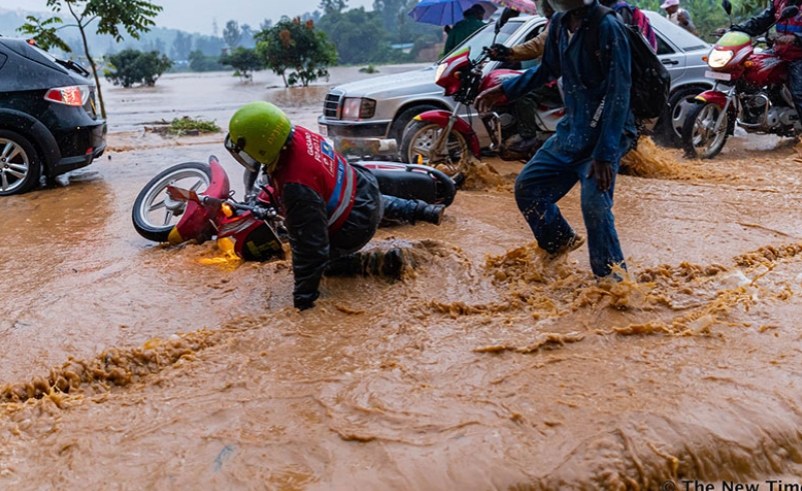
The rain that millions of Rwanda’s poorest residents rely upon to survive is increasingly responsible for new threats to their lives.
The country, known as the Land of a Thousand Hills, has been heavily reliant on predictable and manageable rainfall to produce food.
Its first rainy season of the year used to run from March to May, but changing weather patterns have brought heavy downpours outside of that window, with the national meteorological agency issuing residents a warning via text message about thunderstorms at the start of last week.
After leaving the bustling atmosphere of the capital city Kigali, Rwanda’s captivating and verdant rural landscape – which consists of scatterings of hillside houses among maize fields, banana trees and tea plantations – belies the threat posed by weather emergencies and climate-driven food insecurity.
Eighty per cent of its 14 million population work in agricultural sectors now facing increased challenges from a changing climate.
Heavy rain is really dangerous. We are always worried that any time rain water can come and take over all the things we cultivate
Of those most at risk, Rwandan women, and particularly pregnant women, are disproportionately affected as they often work longer hours for less, face worse health outcomes and gender-based violence, and carry the burden of carrying out demanding farming tasks in their households.
At a remote village around 550 metres above sea level in the Karongi district, 28-year-old Uwamahoro Uwitonze explained that the house she was living in with her mother, her daughter Ineza and her niece Vanessa had been destroyed by flooding.
The family is featured as part of a major fundraising campaign for the Irish international aid charity Trócaire, which works with partners in 20 countries to run development and humanitarian programmes
Speaking to the Press Association at her home, Ms Uwitonze said: “It was in very bad condition because the rain was coming in through many holes. It was really hard for the family.
“The heavy rain is really dangerous for us. We are always worried that any time rain water can come and take over all the things we cultivate.”

A storm-damaged roof in the Karongi District of Rwanda. Photo: Brian Lawless/PA
Some days, she was relying on a daily income of 1,000 Rwanda francs – roughly 60c – to support the household.
Due to the support of Trócaire and its partners, their home has been rebuilt for their safe shelter and Ms Uwitonze has been provided with a water tank and a sewing machine to create clothing to bolster the household income.
Her mother Verediana, a survivor of the Rwandan genocide, expressed gratitude for the support, reflecting on the fear that the home was near collapse.
She said Ms Uwitonze and her other daughter had difficult lives relying on insecure and small agricultural jobs, which can become more scarce due to the effects of climate change.
A sudden rise in the temperature signals that a thunderstorm is approaching, one of several in recent days that led the only road up to the village to be impassable by car.
The resulting downpour illustrates Ms Uwitonze’s relief at her “beautiful” rebuilt home as she recalls how her family could not eat, cook, or sleep during the heavy rains because they feared they would die if the old house collapsed.
And the threats remain: a small area of farmland where she grows crops has been gradually getting smaller due to a landslide encroaching towards her home, while the risk of new flooding from higher ground remains.
The threat is demonstrated by her neighbour Anne Marie Mukankuranga, whose kitchen and toilet collapsed on the area of higher ground due to storms just two days earlier.
She and her husband Ahimana Estorico, who has a disability, said they are “worried for their lives” because they do not have the means to repair the property or move to a safer location.
Communities are attempting to protect against landslides by terracing hillsides and collecting rainwater in tanks
Trócaire’s goals in Rwanda include promoting climate and environmental justice, as well as the empowerment of women and girls.
The charity’s approach is focused on working with local partner organisations and Rwanda’s government to run programmes to address the specific needs of communities holistically.
Its outreach is supported through donations to its major Lenten fundraising appeal where Trócaire collection boxes are distributed to schools and churches around the country.
It also works in collaboration with the development co-operation programmes of the Irish and Scottish governments. One of Trócaire’s key partners in Rwanda is the women-led NGO Duterimbere.
Speaking at the site of a landslide where 48 homes were wiped out in 2024, Duterimbere programme manager Fred Rwibasira said interventions with affected people are focused on sustainability and providing people with support and knowledge to redevelop their lives.
He said that communities are attempting to protect against landslides by terracing hillsides and collecting rainwater in tanks, while Scottish government funding was used to relocate affected families.
Near to Ms Uwitonze’s home within the Karongi district, Duterimbere also works with a co-operative farming and plant nursery that has been operating successfully for three years and is made up of women and men, some of whom have disabilities.
Participants in the Trócaire-supported programme said it gave a voice to women and others who were previously hidden in their homes.
Those who have contributed so little to the climate crisis are feeling the worst impacts
Donathile Nyirabaturanyi, who has a disability affecting her arms, participates in the farming activities and said the co-operative also allows people to access savings and loans.
“It is really nice being here because as a woman with a disability I used to hide myself and I did not think I could get as far as where I am today because I had no access to money at all,” she said.
Claire Kelly, Trócaire’s head of communications, said some families are choosing whether to “bring their kids to school or put food on the table”.
She said it was “one of the greatest injustices of the time” as “those who have contributed so little to the climate crisis are feeling the worst impacts”.
Ms Uwitonze was among those who commented on the common Rwandan refrain that “rain is a blessing”, but said this is not always the case when it falls so heavily.
Faustin Vuningoma, co-ordinator of the Rwanda Climate Change and Development Network, agreed.

Faustin Vuningoma, co-ordinator of the Rwanda Climate Change and Development Network, at his office in Kigali, Rwanda. Photo: Brian Lawless/PA
He said rain is falling with high intensity over a short period of time on degraded land with low water retention. The uncertainty about when rain will fall and how long dry periods could last also contributes to low yields.
He said: “The rain is no longer a blessing every time because it has changed the way it is falling and has created the catastrophes.”
Mr Vuningoma said 80pc of the country’s population who work in agriculture are “quite vulnerable” due to food insecurity and “severe cases of climate change”.
He said there is “a lot of injustice” given that Rwanda’s contribution to global greenhouse gas emissions is below 0.01pc, with all African states accounting for just 4pc. Trócaire works with the network to find sustainable means of food production.
Mr Vuningoma said that countries such as Ireland should use their influence to ensure that Europe lives up to its climate obligations.
“Even if Rwanda and the entire Africa were to be net zero, still they would be hit by climate change – the atmosphere does not have boundaries.”
Email Us on editorial@nnafrica.com