

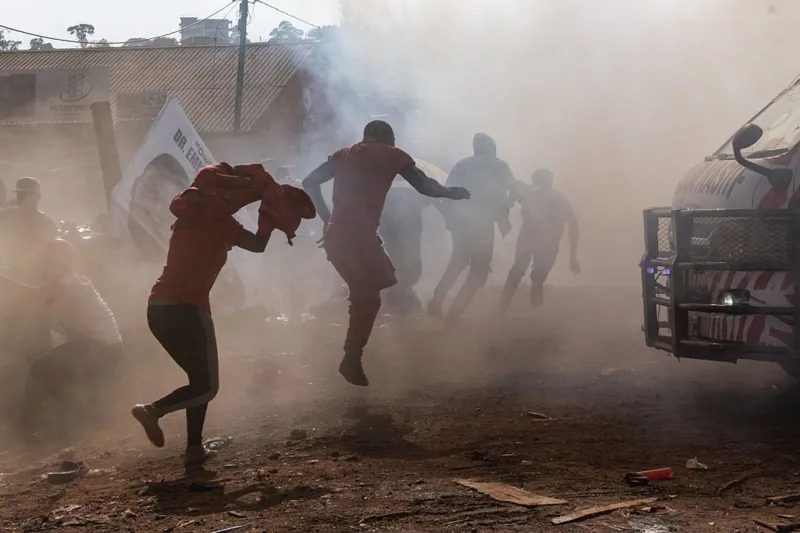
October’s shocking events in Tanzania offer a snapshot of some of the tensions which have shaped a difficult year for African politics.
Demonstrators were shot dead by police while protesting against what they saw as a rigged election – condemned by regional and continental bodies – shattering the country’s reputation for peace and stability.
With opposition candidates either imprisoned or barred from running, President Samia Suluhu Hassan was elected with 98% of the votes.
Any moves towards Tanzania becoming a more open democracy had been seemingly reversed.
Arguably what happened there highlighted a broader breakdown in many African nations between the people and those who govern them.
Several countries saw protests and election disputes in 2025, while military leaders cemented their power in others, with analysts believing next year could bring more upheaval.
“If we look at the overall picture across the continent, the trend is worrying,” said Mo Ibrahim, whose foundation analyses data to assess the state of African governance.
Its most recent report suggests that in its measure of governance, which includes things like security, participation in decision-making and the state of health and education, progress has stalled when compared to the decade up to 2022.
“The increase in coups [in recent years], the return of military governments and the closing of democratic space all point to the same problem: a failure of governance.”
The spike in the cost of living has been the spark that lit the fire of dissatisfaction in many places. This was not unique to the continent but, as Mr Ibrahim told the BBC, “the risk for Africa is that these negative patterns spread unchecked, much of the hard-won progress achieved over recent decades could be reversed”.
For those who believe that democracy is the best way to channel the demands of the population, there have been some points of positivity in 2025 with peaceful transfers of power and free and fair elections.
In Malawi the country’s former leader, Peter Mutharika, won back the presidency after a period in opposition.
Seychelles saw long-term ruling party United Seychelles returned to office, five years after losing power.
Both incumbents lost in part because of a perceived failure to mitigate the impact of inflation.
These results followed other setbacks for ruling parties in 2024.
In South Africa, the African National Congress lost its overall majority for the first time since 1994 and entered a power-sharing government with its main opposition.
In Senegal, a combination of street protests and the courts prevented apparent attempts by the president to extend his time in office and a relative unknown was elected president after the main opposition leader was barred.
But analysts point to shifts elsewhere as evidence that democracy on the continent is being challenged.
Perhaps no more so than through the consolidation of the power of military-led governments across West Africa’s Sahel region.
Mali, Niger, and Burkina Faso all split from the regional bloc, Ecowas, forming a new alliance of governments which seized power through coups.
Where democracy does still exist, analysts point to demographics as a driver of tension.
Africa is the continent with the youngest population but it has the world’s oldest leaders. In many places social media is helping to inform a younger generation which increasingly demands to be heard.
In Cameroon the average age, according to the UN, is just over 18. Yet the country this year saw the consolidation in power of Paul Biya – the planet’s most aged president.
The 92-year-old, who has held office for 43 years, was sworn in for an eighth term, which could see him rule until he is almost 100.
This followed a round of divisive elections in October, condemned by critics as neither free nor fair – a charge rejected by the authorities.
The response from the security forces was not as deadly but, as in Tanzania, anger about the result turned into days of demonstrations – the clearest sign yet of a youthful population prepared to openly challenge Cameroon’s long-term leader.
The protests in Cameroon and Tanzania did not lead to change. But for those considering direct action elsewhere, there were lessons in 2025 of how protest can produce results.
In September, the Indian Ocean island nation of Madagascar was rocked by weeks of youth-led protests against poor service delivery, forcing the country’s President Andry Rajoelina to sack his entire cabinet.
But it was not enough to save his leadership. The protests continued and in October Rajoelina was deposed in a coup. The country’s military has since installed former officer Michael Randrianirina as interim president.
While military takeovers are obviously a setback for democracy, they can serve as a reminder to civilian leaders that they need to listen to the demands of their electorate.
Many analysts believe demonstrations could be a growing feature of Africa’s politics.
“We’re seeing a lot of protests,” said Nerima Wako, executive director of Saisa, a Kenyan organisation which works to help young people engage in politics. “It’s not the best way to effect change, but often it’s the only way.
“Lobbying, petitions, SMSs to parliamentarians, emails. You’re told these are the systems you need to use. When they don’t work, all you’re left with is protest.”
“We’re seeing broken social contracts,” she adds. “Across Africa young people are demanding access to health, to water, to opportunities.
“They’re asking the right things, these are things that governments are meant to provide, but the risk is that governments don’t move quickly enough.”
For Adem Abebe, senior adviser to the International Institute for Democracy and Electoral Assistance, this public disillusionment is key.
“The sense of satisfaction is going down,” he said. “People aren’t happy in what they’re getting, there’s a growing sense of anger about faltering political freedoms and the lack of service delivery.”
But the analyst also points to the role of politics beyond the continent – with many Western governments distracted by crises elsewhere.
He argues that geopolitics has given the continent’s governments more leeway as they slide towards authoritarianism.
The US, once seen as interested in using its power and influence to bolster democracy, is now more concerned with a transactional relationship under President Donald Trump.
“In the past Europe and the West insisted on democratic systems as the price of their engagement in Africa,” Mr Adem said.
“Democratic partners are retreating and African governments have leverage – they have options, like China or Russia, and they have the opportunity to pursue their objectives without fear of the admonishment of global partners.”
Whatever is driving the change, few doubt that African governance faces an uncertain future.
The final weeks of 2025 have seen another coup, in the West African state of Guinea-Bissau, bringing the total to eight of countries on the continent now run by the military.
There was also an attempted coup in Benin that triggered a swift response from Ecowas, showing a resolve missing following the region’s recent successful military takeovers. The reaction could herald a stiffer defence of democracy in West Africa.
The first weeks of January will bring an election in Uganda – ruled for 40 years by President Yoweri Museveni, 81. Previous polls in that country have been marred by allegations of irregularities and violence.
For Mr Ibrahim, a key question now is how African governments respond to what they hear from the continent’s young.
“Africa’s youth has become its demographic majority,” he says. “This must translate in democratic practice.
“If we listen to them, invest in them, respect their rights and consider their expectations, then the coming years can mark a real turning-point for the continent.”
“We are in a crisis,” says Ms Wako. “Look around Africa and you see too many governments which are slow to respond.
“We’ve entered a new dispensation in terms of the relationship between people and power.
“The governments which get that fast will be the ones who survive.”
Email Us on editorial@nnafrica.com